
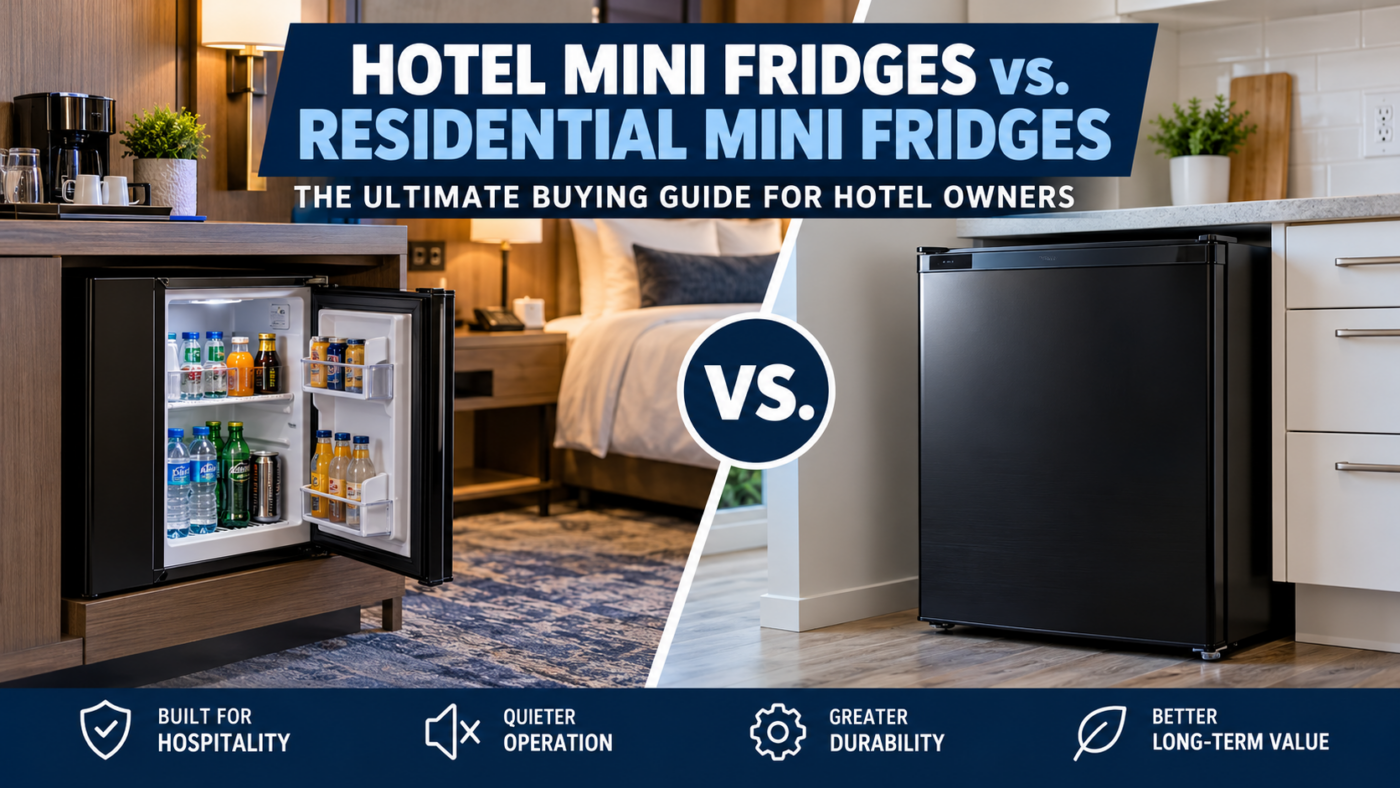
Choosing the right mini refrigerator for your hotel is about more than keeping beverages cold. It directly affects guest satisfaction, housekeeping efficiency, maintenance expenses, energy consumption, and your property’s long-term operating costs.
When comparing hotel mini fridges vs. residential mini fridges, hotel owners and purchasing managers often discover that the lowest purchase price does not necessarily deliver the best long-term value.
A residential mini fridge might appear to be a budget-friendly solution for a few guest rooms. However, when purchasing refrigerators for 50, 100, or 300 hotel rooms, factors such as durability, noise levels, warranty coverage, electrical requirements, and replacement logistics become increasingly important.
Hospitality-oriented refrigerators are selected to address the practical demands of commercial lodging environments. They can offer features such as compact cabinet dimensions, quieter operation, guest-friendly layouts, and finishes that complement hotel room furniture.
At Elevate B2B, we help hotels, resorts, casinos, and commercial properties evaluate hospitality appliances, coordinate purchasing, and plan equipment upgrades.
Whether you’re opening a new property, completing a Property Improvement Plan (PIP), or replacing aging guest room refrigerators, selecting the appropriate equipment can help protect your investment.
Ready to upgrade your guest room refrigerators? Call (833) 351-5333 to discuss bulk purchasing, hospitality appliance options, and financing availability.
Table of Contents
What Is the Difference Between Hotel Mini Fridges and Residential Mini Fridges?
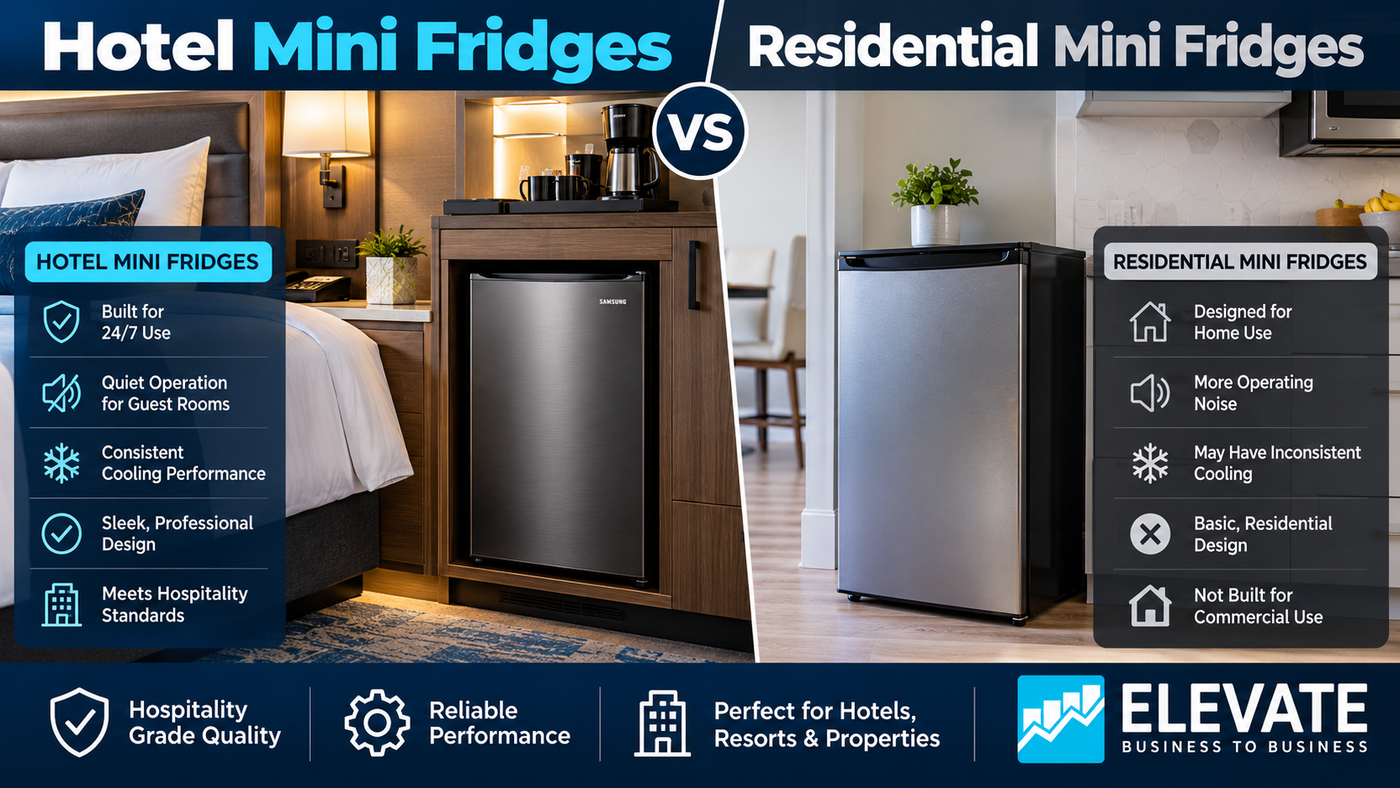
Although hotel and residential mini refrigerators may look similar, their intended applications can be different.
A residential mini fridge is generally designed for personal use in bedrooms, apartments, dormitories, home offices, or recreational spaces.
A hotel mini fridge is selected or designed for guest room environments, where multiple people may use the appliance over time and the property needs consistent performance across numerous rooms.
The distinction is not simply whether the refrigerator is labeled commercial or residential. Actual performance depends on the manufacturer, product specifications, warranty terms, and installation conditions.
Hotel Mini Refrigerators
Hospitality-oriented mini refrigerators may offer:
- Compact dimensions suited to guest room furniture.
- Low-noise or thermoelectric cooling options.
- Reversible doors on select models.
- Guest-friendly interior storage configurations.
- Energy-efficient operating features.
- Manufacturer support for lodging applications.
- Product availability suited to multi-room purchasing.
For hotel owners, consistent model selection across rooms can simplify maintenance, replacement planning, and housekeeping procedures.
Residential Mini Refrigerators
Residential mini fridges are typically marketed toward individual consumers and may offer:
- Lower entry-level purchase prices.
- Broad availability through retail stores.
- Standard compressor-based cooling.
- Various capacities and exterior finishes.
- Household-oriented warranties.
- Convenient purchasing for small quantities.
Residential models can be suitable for certain lodging applications, but hotel owners should confirm whether commercial use is permitted under the warranty.
The key question is not simply which refrigerator costs less today. It is which refrigerator delivers the best combination of performance, guest satisfaction, and total ownership cost.
Hotel Mini Fridges vs. Residential Mini Fridges: Side-by-Side Comparison
| Feature | Hotel Mini Fridges | Residential Mini Fridges |
|---|---|---|
| Primary application | Guest rooms and hospitality properties | Homes, dormitories, offices |
| Noise control | Quiet-operation options often prioritized | Varies by model |
| Durability | Depends on hospitality specifications | Depends on consumer model |
| Warranty | May cover hospitality use | Commercial use may be excluded |
| Bulk purchasing | Often available through B2B suppliers | Retail or distributor purchasing |
| Installation | Selected for guest room furniture and ventilation | Designed for general household placement |
| Maintenance | Standardized fleets can simplify servicing | Mixed retail models can complicate servicing |
| Energy efficiency | Model-dependent | Model-dependent |
| Upfront price | Varies by specification and volume | Budget models may cost less |
| Long-term value | Can favor property-wide standardization | Can work for smaller or limited-use properties |
A hotel-specific model is not automatically superior in every category. Comparing actual specifications is essential.
For additional purchasing considerations, explore the Elevate B2B Hospitality Appliance Buying Guide.
Why Hotel Mini Fridge Durability Matters
Hotels operate differently from residential households.
A household refrigerator may be opened by the same few people every day. A hotel mini refrigerator may serve hundreds of different guests over its operating life.
Guest behavior also varies. Some guests store beverages, others store leftovers, and some repeatedly adjust temperature settings.
Housekeeping employees may need to inspect, clean, and occasionally move appliances during routine maintenance.
These conditions make product construction and serviceability important purchasing considerations.
Construction Quality and Reliability
When evaluating refrigerators for hotels, consider the following components:
Door hinges and seals: Durable hinges and properly fitted door gaskets help maintain cooling performance and reduce unnecessary energy consumption.
Interior shelving: Shelves should withstand routine use and allow housekeeping staff to clean the refrigerator efficiently.
Temperature controls: Accessible, dependable controls can reduce guest complaints about improperly cooled beverages or food.
Exterior finish: Surfaces that resist everyday scratches and are easy to clean can maintain a more professional appearance.
Cooling components: Compressor and thermoelectric systems have different performance characteristics that should be evaluated for the intended environment.
A reliable refrigerator can reduce maintenance interruptions, but no appliance is maintenance-free.
Working with a hospitality equipment supplier can help purchasing managers compare models based on their property’s actual operating requirements.
Noise Levels: An Overlooked Guest Satisfaction Factor
Imagine a guest checking into a hotel after a long flight.
The room is clean, the bed is comfortable, and everything looks perfect. Then, just as the guest falls asleep, the refrigerator compressor starts cycling.
Even a relatively quiet appliance can become noticeable in a small guest room.
Noise is one reason hospitality buyers should pay attention to refrigeration technology and manufacturer specifications.
Compressor-Based Mini Refrigerators
Compressor refrigerators use a mechanical refrigeration system to remove heat from the interior compartment.
Advantages can include effective cooling performance and suitability for a broader range of temperature requirements, depending on the model.
Potential disadvantages include compressor cycling sounds and vibration.
However, modern compressor models can be relatively quiet, and actual sound levels vary considerably.
Thermoelectric Mini Refrigerators
Thermoelectric refrigerators use electronic cooling technology rather than a traditional compressor.
Some models provide quiet operation, making them attractive for guest rooms where noise reduction is a priority.
However, thermoelectric cooling performance is influenced by surrounding room temperature, ventilation, and the manufacturer’s design.
They may not be appropriate for every food-storage application.
Important: If a refrigerator will be used for medications or temperature-sensitive foods, select equipment with documented temperature performance suitable for that purpose. Do not assume every minibar-style refrigerator provides food-safe refrigeration.
For hospitality properties, the best choice depends on room layout, guest expectations, ambient temperatures, and the intended contents.
Energy Efficiency and Long-Term Operating Costs
Electricity consumption may seem insignificant when evaluating one refrigerator.
Across hundreds of guest rooms, however, even small differences in annual energy usage can affect a property’s operating budget.
Consider a hypothetical hotel with 150 guest rooms.
If one refrigerator consumes 40 fewer kilowatt-hours annually than another, the property could reduce annual electricity consumption by:
150 refrigerators × 40 kWh = 6,000 kWh annually
At an illustrative electricity rate of $0.18 per kWh, that represents approximately $1,080 in annual electricity savings.
Over five years, the potential savings would total $5,400, assuming the same usage and electricity rate.
These figures are an illustration, not a performance claim for a particular refrigerator.
Energy efficiency should be evaluated using actual manufacturer specifications, applicable energy certifications, and expected operating conditions.
Hotel owners should also consider the effect of appliance heat output on room cooling demands, especially in warm climates.
A refrigerator with a slightly higher purchase price may provide better overall value when operating costs are considered.
PART 2 OF 3 — PURCHASING, PRODUCT SELECTION & FINANCING
How Much Do Hotel Mini Fridges Cost Compared to Residential Models?
Purchase price is often the first consideration for hotel owners planning a refrigerator replacement project.
However, comparing two refrigerators based only on their advertised prices can create a misleading picture.
A residential mini refrigerator might have a lower initial cost, but the overall investment also includes freight, installation, warranty coverage, maintenance, and future replacement expenses.
Hotel purchasing managers should evaluate the total cost of ownership, not just the initial invoice.
Understanding Total Cost of Ownership
Consider a hypothetical hotel purchasing 100 refrigerators.
| Expense | Residential Option | Hospitality Option |
|---|---|---|
| Unit price | $150 | $210 |
| Quantity | 100 | 100 |
| Initial equipment cost | $15,000 | $21,000 |
| Estimated five-year service and replacement costs | $7,500 | $3,000 |
| Illustrative five-year total | $22,500 | $24,000 |
These numbers are hypothetical and exclude freight, installation, electricity, and other expenses.
In this example, the residential option remains less expensive overall, despite higher assumed service costs. That illustrates why buyers should avoid assuming that hospitality models always provide the lowest total cost.
If maintenance costs, replacement rates, or energy consumption differ, the calculation may change.
A smart purchasing decision considers:
- Initial equipment pricing and quantity discounts.
- Manufacturer warranty coverage for hotel use.
- Expected appliance lifespan and repairability.
- Annual electricity consumption.
- Shipping and installation expenses.
- Replacement inventory availability.
- Operational disruption from failed appliances.
For hotels planning larger purchases, obtaining a project-specific quote is often more useful than comparing individual retail prices.
Elevate B2B offers a selection of mini refrigerators for hospitality properties and can assist buyers with equipment selection and purchasing requirements.
Best Mini Fridge Sizes for Hotel Guest Rooms
Mini refrigerator capacity should reflect the hotel’s room type, guest profile, and available space.
A compact refrigerator that works well in a standard overnight guest room may be too small for an extended-stay suite.
Likewise, a large refrigerator can occupy valuable floor space and create unnecessary installation challenges in a smaller room.
30-Liter Mini Refrigerators
A 30-liter refrigerator may be appropriate for properties that primarily need compact beverage storage.
These models can fit certain guest room configurations where space is limited.
They are worth considering for boutique hotels, urban properties, and smaller guest rooms.
40-Liter Mini Refrigerators
A 40-liter refrigerator provides additional storage without necessarily requiring the footprint of a larger appliance.
This capacity can work well for standard hotel rooms that accommodate bottled beverages, snacks, and a limited amount of guest food.
50-Liter Mini Refrigerators
A 50-liter refrigerator offers more flexibility for properties serving leisure travelers, business guests, and families.
Depending on the interior configuration, guests may have more room for beverages, takeout containers, and other refrigerated items.
60- to 70-Liter Mini Refrigerators
Larger compact refrigerators can be attractive for suites, upscale accommodations, and properties with longer average guest stays.
However, larger capacity does not automatically mean better value. Hotels should compare physical dimensions, energy consumption, cooling performance, and guest demand.
Elevate B2B lists multiple Innovative Hospitality models, including 30-, 40-, 50-, 60-, and 70-liter configurations, along with other compact refrigeration products. Elevate B2B+1
Best Hotel Mini Fridge Brands and Options
Selecting a reliable supplier is just as important as selecting the right refrigerator.
Hotel owners should compare available models from manufacturers and suppliers that understand commercial lodging requirements.
Innovative Hospitality Mini Refrigerators
Innovative Hospitality offers a variety of compact refrigerator and minibar configurations.
Elevate B2B carries models featuring solid doors, frameless glass doors, and drawer-style designs.
These configurations allow hotels to select appliances that complement different room layouts and furniture designs.
Solid-door models can provide a discreet appearance, while glass-door configurations can make beverages more visible.
Drawer-style refrigerators may be useful in certain custom cabinetry applications, provided the manufacturer’s installation requirements are met.
Danby Compact Refrigerators
Danby is another brand worth evaluating for hospitality refrigeration projects.
Depending on the model, features can include adjustable shelving, reversible doors, compact dimensions, and energy-efficient operation.
For example, Danby’s DAR016A1BDB specification sheet identifies a 1.6-cubic-foot capacity, ENERGY STAR certification, an automatic defrost system, and a reversible door hinge. These specifications apply to that particular model, not every Danby refrigerator. elevate-b2b.com
Hotel buyers should confirm the current model specifications and applicable commercial warranty before purchasing.
Other Hospitality Refrigeration Options
Elevate B2B also lists refrigeration products from manufacturers such as GE, Haier, and Galanz.
The ideal selection depends on whether the property needs a compact guest room refrigerator, a larger suite appliance, or a refrigerator-freezer combination.
For a broader overview of available equipment, explore hospitality appliances from Elevate B2B.
Why Bulk Mini Fridge Purchasing Makes Sense for Hotels
Purchasing refrigerators individually from multiple retail stores may work for a small number of emergency replacements.
However, it can become inefficient when outfitting an entire property.
A 200-room hotel purchasing different refrigerator models over several months may encounter inconsistent dimensions, door configurations, temperature controls, and warranty terms.
Standardized purchasing can reduce those complications.
Consistent Guest Room Appearance
When refrigerators share the same exterior design and dimensions, guest rooms can maintain a consistent appearance.
This matters particularly for branded hotels, upscale properties, and renovation projects with standardized furniture specifications.
Simplified Maintenance
Maintenance teams can become familiar with a smaller number of appliance models.
Standardization may simplify parts identification, cleaning procedures, troubleshooting, and replacement planning.
Coordinated Delivery
Bulk purchasing can help hotel owners plan deliveries around room renovation schedules.
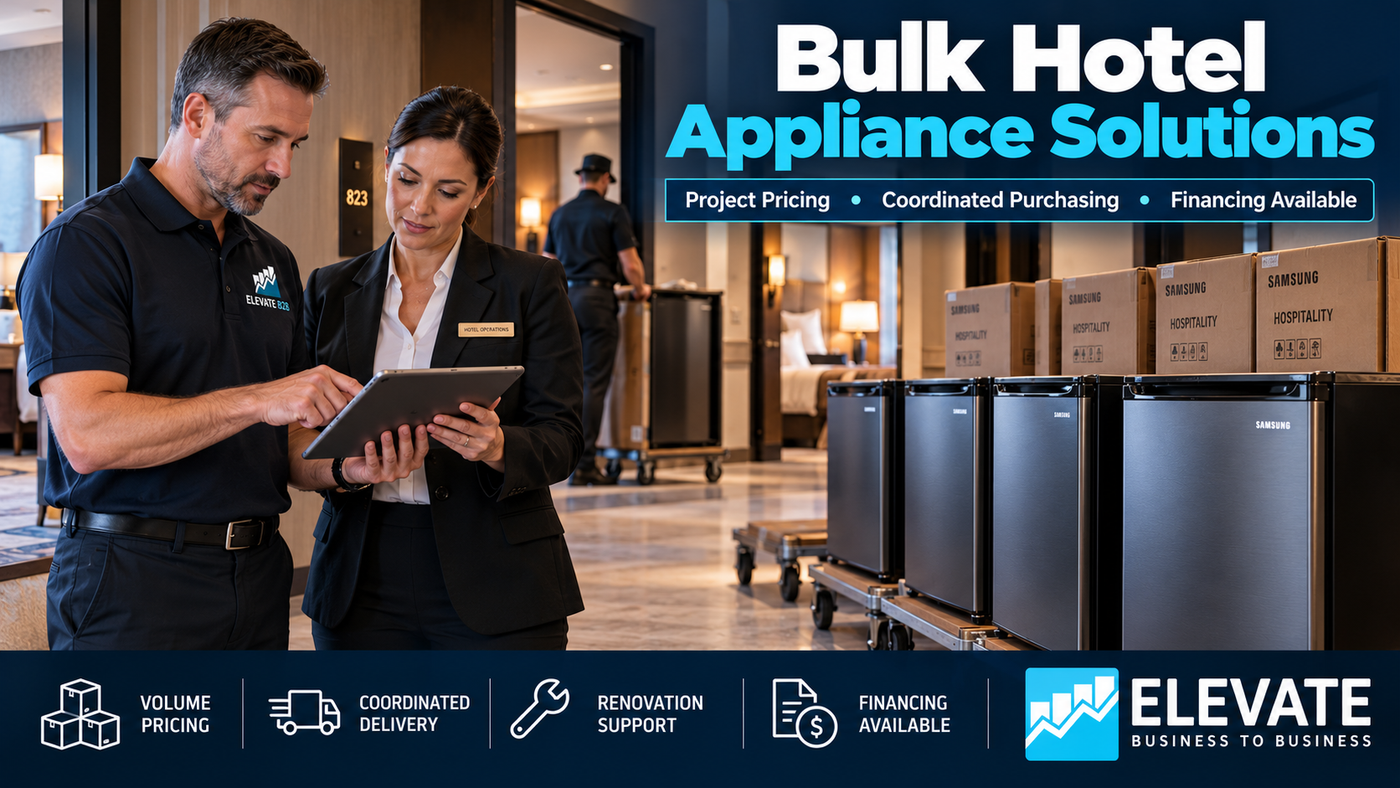
Instead of receiving appliances in scattered shipments, a property can discuss coordinated logistics with its supplier.
Better Budget Planning
A consolidated equipment quote gives purchasing managers a clearer picture of project expenses.
For properties upgrading several categories simultaneously, Elevate B2B can also help source hospitality TVs, Samsung hotel televisions, microwaves, safes, and other guest room equipment.
This makes it easier to plan a comprehensive renovation rather than treating every product category as a separate purchasing project.
Financing Available for Hotel Mini Fridges and Hospitality Appliances
A hotel refrigerator replacement project can require a significant upfront investment.
For example, replacing refrigerators across 250 guest rooms can involve equipment costs, freight, installation, and related renovation expenses.
Rather than delaying necessary upgrades, qualified commercial buyers can explore equipment financing.
Elevate B2B works with Ascentium Capital to offer commercial financing and leasing solutions.
According to Elevate B2B’s published financing program, available options include:
- Financing and leasing up to $2 million.
- Application-only financing up to $250,000.
- Potential $0-down financing options.
- Deferred payment options.
- Fast credit decisions and flexible terms.
- Potential tax advantages for eligible businesses.
- Financing structures that may include shipping, taxes, and other qualifying expenses.
All financing is subject to credit approval, eligibility, documentation, and current program requirements. Tax treatment should be reviewed with a qualified tax professional. Elevate B2B
Why Financing Can Help Hotel Owners
Financing may allow a property to preserve working capital for payroll, maintenance, marketing, and other operating needs.
It can also help ownership coordinate multiple improvements during the same renovation cycle.
For example, a hotel planning to replace aging refrigerators may also need new televisions, commercial TV mounts, microwaves, or guest room safes.
Combining eligible purchases into a coordinated equipment project may simplify budget planning.
Financing available: Review Elevate B2B financing options or call (833) 351-5333 to discuss your project’s requirements.
Hotel Renovations and Property Improvement Plans
Hotel renovations often involve more than replacing furniture and repainting walls.
Owners may need to modernize appliances, improve guest room entertainment, replace outdated equipment, and meet applicable brand standards.
For franchised hotels, a Property Improvement Plan can establish requirements and deadlines for approved upgrades.
Although individual franchise requirements vary, equipment selection should be reviewed early in the planning process.
Purchasing managers should confirm whether proposed refrigerators satisfy any applicable brand specifications before placing a large order.
For properties also upgrading entertainment systems, Elevate B2B offers a Guide to Hospitality TV that discusses television selection and hotel technology considerations.
Hotel owners evaluating broader renovations can also review hotel TV solutions and digital signage solutions for public areas, lobbies, and guest-facing communication.
A coordinated purchasing strategy can help reduce avoidable delays and ensure the equipment selected supports the property’s operational goals.
Hotel Mini Fridges vs. Residential Mini Fridges: Which Should Your Property Choose?
The best refrigerator depends on your property’s size, budget, guest expectations, and operating requirements.
For a small independent property replacing one or two refrigerators, a suitable residential model may be a practical option if the manufacturer permits hotel use.
For a large hotel replacing 100 or more units, standardized hospitality refrigerators may provide advantages in procurement, maintenance planning, and room consistency.
Extended-stay hotels should place particular emphasis on capacity and reliable food-storage temperatures. Luxury hotels may prioritize low operating noise, premium finishes, and integration with guest room furniture.
Before purchasing, compare actual product specifications, warranty coverage, energy consumption, installation requirements, and complete delivered costs.
Case Study 1: A 120-Room Hotel Evaluates Bulk Replacement
Illustrative purchasing scenario, not a documented Elevate B2B customer result.
A 120-room hotel is preparing to replace aging guest room refrigerators. Management is considering inexpensive residential models to control upfront costs.
After evaluating the project, the purchasing team discovers that several residential models have different dimensions and commercial-use warranty limitations.
The hotel decides to request pricing for standardized hospitality refrigerators with appropriate dimensions and documented warranty coverage.
Rather than selecting products based on purchase price alone, management compares total project expenses, delivery arrangements, and expected maintenance requirements.
Key takeaway: Standardized purchasing can make a large refrigerator replacement project easier to manage, even when the initial equipment investment is higher.
For additional planning guidance, read Elevate B2B’s Hotel Refrigerator Replacement Program: Smart Savings Guide.
Case Study 2: An Extended-Stay Property Needs More Capacity
Illustrative scenario, not a documented customer project.
An extended-stay property wants to improve guest room refrigeration in 80 suites.
The existing compact refrigerators are too small for guests staying several days or weeks.
Management evaluates larger-capacity refrigerator models, paying attention to food-storage temperatures, interior shelving, and available kitchenette space.
The purchasing team also considers coordinating refrigerator and microwave replacements during the same renovation period.
Key takeaway: Matching refrigerator capacity to the guest’s length of stay can deliver more practical value than simply choosing the smallest available appliance.
For more information about appliance selection, explore Elevate B2B’s Hospitality Refrigerators Guide.
Case Study 3: A Hotel Group Coordinates Equipment Financing
Illustrative scenario, not a documented customer project.
A hospitality management company operates three properties and wants to upgrade refrigerators, televisions, and selected guest room appliances.
Rather than purchasing each equipment category independently, management develops a consolidated purchasing plan.
The company compares supplier quotations, reviews equipment compatibility, and explores commercial financing to preserve working capital.
The purchasing team establishes separate delivery schedules for each property while maintaining consistent product specifications where appropriate.
Key takeaway: Coordinating purchasing and evaluating financing can help multi-property operators manage renovation budgets and equipment procurement more effectively.
Elevate B2B offers commercial financing options for qualified businesses through Ascentium Capital, subject to approval and program terms.
Why Work With Elevate B2B for Hospitality Appliances?
Elevate B2B understands that hotel purchasing decisions affect more than the equipment budget.
The right appliances can support a comfortable guest experience, consistent room presentation, and more manageable maintenance operations.
Whether your property needs compact refrigerators, minibars, microwaves, safes, or a complete guest room technology upgrade, Elevate B2B can help you evaluate available solutions.
Our offerings extend beyond refrigeration to include hotel TV systems, smart TVs for hotels, commercial displays, and hospitality digital signage.
Purchasing multiple equipment categories through a hospitality-focused supplier can simplify communication and support coordinated project planning.
Ready for a project quote? Contact Elevate B2B at (833) 351-5333 to discuss quantities, product specifications, delivery requirements, and financing availability.
Frequently Asked Questions
1. Are hotel mini fridges better than residential mini fridges?
Not necessarily in every situation. Hospitality refrigerators may offer configurations and purchasing advantages suited to hotels, while certain residential models may work for smaller properties. The best choice depends on specifications, warranty coverage, operating conditions, and total cost.
2. Can hotels use residential mini refrigerators?
Yes, provided the selected refrigerator is suitable for the intended application and the manufacturer permits that use. Hotels should verify commercial-use warranty eligibility, installation clearances, electrical requirements, and cooling performance.
3. What is the best mini fridge size for a hotel room?
Many properties evaluate compact refrigerators in the 30- to 70-liter range. The appropriate capacity depends on guest needs, room dimensions, furniture configuration, and whether the appliance will primarily store beverages or refrigerated food.
4. Are hotel mini refrigerators quieter?
Some hospitality refrigerators prioritize quiet operation, but noise levels vary by model and cooling technology. Compare manufacturer sound specifications where available rather than assuming every hospitality refrigerator is quieter than a residential model.
5. Can I purchase hotel mini fridges in bulk?
Yes. Elevate B2B works with commercial hospitality customers seeking bulk appliance purchasing solutions. Order quantities, model availability, and project pricing can be discussed directly with the sales team.
6. Is financing available for hotel refrigerator purchases?
Yes. Financing is available for qualified businesses through Elevate B2B’s partnership with Ascentium Capital. Options may include financing and leasing, potential $0-down arrangements, and deferred payments, subject to credit approval. Review the financing details.
7. How long do hotel mini refrigerators last?
There is no guaranteed lifespan that applies to every model. Longevity depends on construction quality, ventilation, usage, maintenance, operating environment, and cooling technology. Hotels should evaluate repair history and performance when deciding whether replacement is necessary.
8. Does Elevate B2B offer other hotel appliances?
Yes. Elevate B2B supplies categories including refrigerators, freezers, minibars, microwaves, safes, and other hospitality equipment. Buyers can explore Innovative Hospitality Appliances for additional purchasing information.
9. What should hotel owners include in a mini fridge quote request?
Provide the number of refrigerators, preferred capacity, installation dimensions, delivery location, project deadline, and any required features. Include cabinet ventilation requirements and applicable hotel brand standards.
10. How do I contact Elevate B2B for hotel refrigerator pricing?
Call (833) 351-5333 or use the Elevate B2B online contact form to discuss your property, request a quote, or arrange an appointment.
Upgrade Your Hotel Mini Fridges With Elevate B2B
Choosing between hotel mini fridges and residential mini fridges is an important decision for hospitality owners who want to balance cost, reliability, and guest satisfaction.
A successful purchase starts with the right specifications, realistic budget planning, and a supplier that understands hospitality procurement.
Elevate B2B is here to help you compare options, explore bulk purchasing opportunities, and coordinate your next guest room equipment upgrade.
Get competitive project pricing and expert purchasing assistance. Financing is available for qualified businesses. Call (833) 351-5333 today or contact Elevate B2B online to request a quote and arrange an appointment.
