
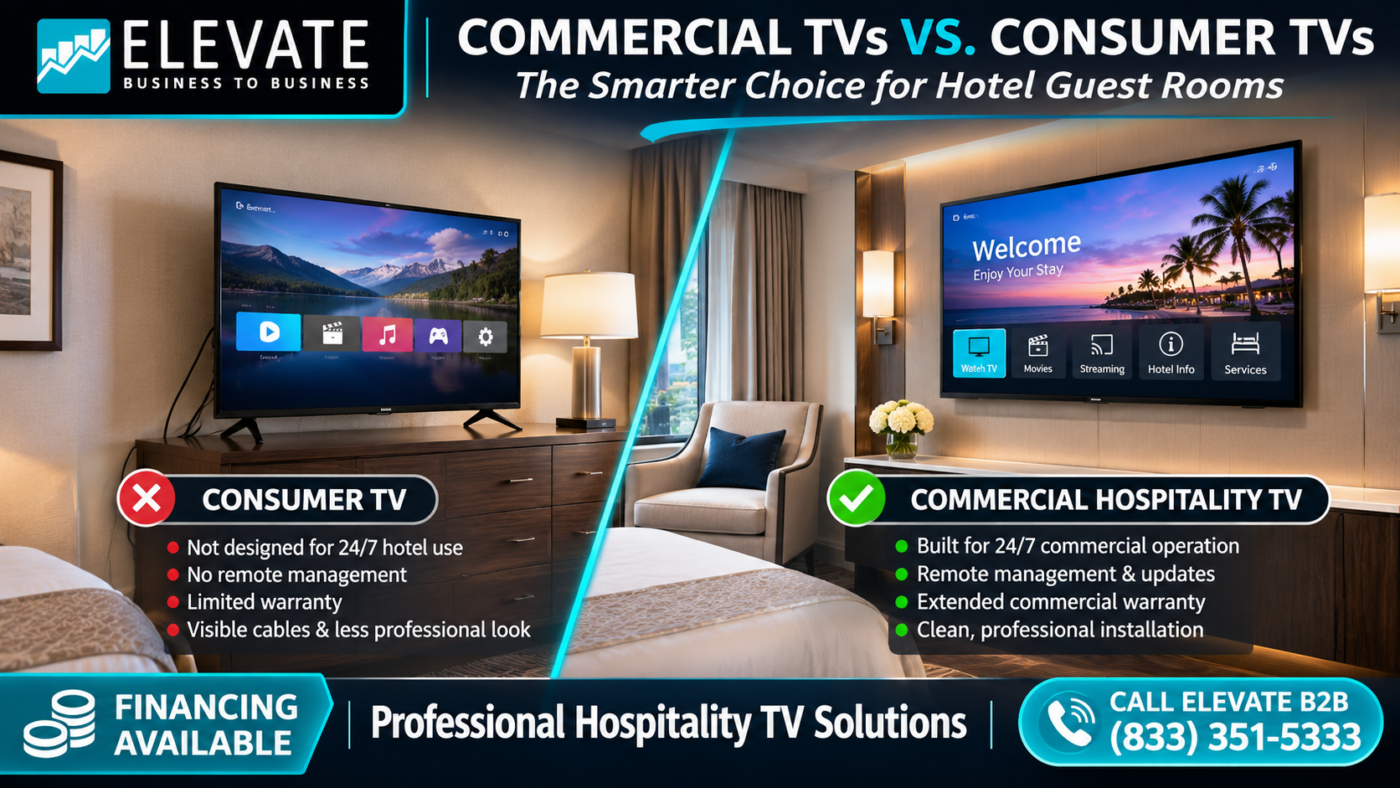
Discover why commercial-grade hospitality televisions are often the smarter long-term investment for hotels, resorts, and extended-stay properties—and how choosing the right equipment can reduce operational headaches while improving the guest experience.
Every hotel owner wants to control expenses without sacrificing guest satisfaction. When purchasing televisions for guest rooms, one question frequently comes up: Should hotels buy commercial TVs instead of consumer TVs?
At first glance, consumer televisions appear to be the more affordable option. They are readily available at electronics retailers, frequently discounted, and offer impressive picture quality. A hotel owner purchasing televisions for 50, 100, or 200 rooms might assume that buying standard retail TVs will save thousands of dollars.
However, the purchase price tells only part of the story.
Commercial-grade hospitality televisions are designed for the operating requirements of hotels. Depending on the model, they can offer centralized configuration, guest-friendly controls, compatibility with hospitality entertainment platforms, and features that help hotel operators maintain consistent room experiences.
Consumer televisions, on the other hand, are primarily designed for individual households.
That difference becomes increasingly important when televisions are installed across dozens or hundreds of guest rooms.
For hotel owners planning renovations, property improvement plans (PIPs), new construction, or television replacement projects, understanding these differences can prevent costly purchasing mistakes.
At Elevate B2B, we help hospitality businesses evaluate commercial televisions, compare Samsung and LG hospitality TV options, and coordinate equipment purchasing and installation requirements.
Planning a hotel TV replacement project? Call (833) 351-5333 to discuss your property, request competitive equipment pricing, and learn about available financing options.
Table of Contents
PART 1: Understanding Commercial TVs vs. Consumer TVs
What Is a Commercial-Grade Hospitality TV?
A commercial-grade hospitality television is designed to support the requirements of hotels, resorts, healthcare facilities, and other managed environments.
Unlike traditional household televisions, hospitality models may include specialized software, configuration tools, restricted settings, and integration capabilities.
These features allow hotel operators to manage how televisions function within guest rooms.
For example, a hotel might want every television to turn on at a predetermined volume, display a welcome screen, or prevent guests from changing critical system settings.
Hospitality televisions can support these requirements when equipped with the appropriate hardware, software, and management platform.
Many commercial models also support installation and management workflows intended for large properties.
For hotel owners comparing options, the Guide to Hospitality TVs provides additional information about selecting televisions for commercial lodging environments.
What Makes Consumer TVs Different?
Consumer televisions are designed primarily for residential entertainment.
They typically emphasize picture quality, streaming applications, gaming features, smart-home compatibility, and retail affordability.
These features are excellent for home use. However, residential functionality does not automatically translate into successful hotel operations.
Consider a guest checking into a hotel room and discovering that the previous occupant left a personal streaming account logged in.
Or imagine a guest changing the television’s language, input settings, or network configuration.
In a residential environment, these situations may be minor inconveniences.
Across a 150-room hotel, however, repeated television issues can create significant work for maintenance teams and front desk employees.
Consumer TVs may also lack the specific compatibility required by a hotel’s entertainment distribution system.
The important distinction is not simply picture quality. It is whether the television can operate reliably within a managed hospitality environment.
Commercial TVs vs. Consumer TVs: Key Differences
| Feature | Commercial Hospitality TVs | Consumer TVs |
|---|---|---|
| Intended environment | Hotels and managed properties | Residential households |
| Guest setting restrictions | Common on hospitality models | Often limited |
| Centralized configuration | Available on supported systems | Generally limited |
| Welcome screen customization | Available on compatible models | Usually limited |
| Hospitality IPTV integration | Model-dependent support | Often requires additional hardware |
| Volume restrictions | Common hospitality feature | Model-dependent |
| Warranty coverage | Commercial terms vary by model | Residential terms may exclude commercial use |
| Bulk purchasing | Available through commercial suppliers | Retail purchasing |
| Streaming capabilities | Platform-dependent guest solutions | Consumer streaming apps |
| Initial purchase price | May be higher | Often lower |
Not every commercial television includes every feature listed above. Hotel owners should verify model specifications, software compatibility, warranty terms, and licensing requirements before purchasing.
1. Commercial TVs Are Designed for Managed Guest Rooms
One of the biggest advantages of hospitality televisions is operational control.
Hotel managers need televisions that behave consistently from room to room.
A guest should not have to troubleshoot complicated settings simply to watch television.
Likewise, housekeeping and maintenance employees should not have to reset every television after checkout.
Depending on the model, commercial hospitality TVs can provide:
- Preset maximum volume levels to help reduce noise complaints.
- Restricted access to advanced configuration menus.
- Default input and channel settings.
- Guest-facing welcome screens.
- Configuration cloning or centralized management.
- Compatibility with supported hotel entertainment systems.
These features are especially valuable for properties managing large numbers of rooms.
For additional equipment options, explore Hospitality TV Solutions from Elevate B2B.
2. Commercial TVs Can Reduce Operational Disruptions
Hotel televisions experience frequent use.
Guests turn them on and off throughout the day, change channels, connect devices, and adjust settings.
A malfunctioning television can lead to maintenance requests, room changes, guest complaints, and potentially negative reviews.
Commercial-grade televisions are engineered for their specified operating environments, although reliability and expected service life vary by model.
Hotel owners should compare more than advertised picture quality.
Important considerations include commercial warranty coverage, replacement availability, installation compatibility, and the manufacturer’s intended usage conditions.
For a property with 200 guest rooms, even a relatively small number of television-related service calls can consume valuable maintenance resources.
Choosing equipment that is easier to configure, support, and replace can improve operational efficiency.
3. Hospitality TVs Offer Better Control Over Guest Settings
Imagine operating a hotel where guests regularly change television settings.
One guest switches the menu language. Another disables the default channel source. A third adjusts the volume to an unreasonable level.
The next guest checks in and cannot immediately use the television.
Hospitality televisions can help reduce these situations by limiting access to selected settings.
Hotel operators can establish standardized configurations, helping ensure that rooms are ready for incoming guests.
This capability becomes particularly important for properties with high occupancy rates and frequent room turnover.
PART 2: Costs, Technology, and Long-Term Hotel Operations
4. Are Commercial TVs More Expensive Than Consumer TVs?
Commercial hospitality televisions may cost more upfront than comparable consumer models.
However, hotel owners should evaluate the total cost of ownership rather than focusing exclusively on the initial purchase price.
The actual cost of a hotel television project can include equipment, mounting hardware, installation, software licensing, replacement inventory, technical support, and maintenance.
Consider this hypothetical purchasing example:
| Expense | Consumer TV | Hospitality TV |
|---|---|---|
| Television purchase price | $300 | $425 |
| Quantity | 100 | 100 |
| Initial equipment investment | $30,000 | $42,500 |
| Difference | $12,500 |
These are illustrative figures, not current Elevate B2B quotes. Actual pricing depends on model, screen size, quantity, availability, and project requirements.
The commercial option costs $12,500 more initially.
But what happens over the next five years?
If consumer televisions require additional configuration visits, replacements, compatibility workarounds, or troubleshooting, the original savings may decrease.
Conversely, a commercial system with unnecessary software or licensing costs may not be the most economical choice for every property.
The right decision requires comparing the complete project cost.
Elevate B2B helps hotel purchasing teams evaluate commercial-grade televisions and related equipment for their specific requirements.
Explore available Hotel TVs or call (833) 351-5333 for assistance with bulk purchasing.
5. Commercial TVs Support More Consistent Guest Experiences
Modern travelers expect convenient in-room entertainment.
Many guests want access to familiar television channels, streaming options, and easy-to-navigate interfaces.
Hotel owners must deliver these conveniences while protecting guest privacy and maintaining system reliability.
Hospitality televisions can support customized welcome experiences, hotel information, and entertainment interfaces when paired with compatible platforms.
Some hotel TV systems also provide casting or streaming capabilities that allow guests to enjoy content from supported services.
However, hotel operators should not assume that a television with built-in Netflix automatically meets hospitality requirements.
Guest authentication, account privacy, automatic logout, content licensing, and system integration must all be evaluated.
For more information about modern entertainment options, read Smart TVs for Hotels.
6. Hospitality IPTV Systems and Integration
Internet Protocol Television, commonly called IPTV, distributes television programming through an IP-based network.
For hotels, IPTV can support features such as channel distribution, interactive menus, property information, and centralized content management.
Depending on the solution, hotels may also integrate entertainment services with other property technology.
Commercial hospitality televisions are often selected because they support specific IPTV or hospitality management platforms.
However, compatibility is not universal.
Before purchasing televisions, hotel owners should confirm:
- Whether the property uses coaxial, IP-based, or hybrid television distribution.
- Which hospitality entertainment platform is installed.
- Whether televisions require Pro:Idiom or other content-protection support.
- Whether additional set-top boxes or licensing are necessary.
- Whether the network can support the intended entertainment services.
- Whether the proposed televisions are approved for the property’s brand requirements.
A television that looks impressive on a retail showroom floor may not work with the existing hotel infrastructure.
This is why equipment selection should happen before large-scale purchasing.
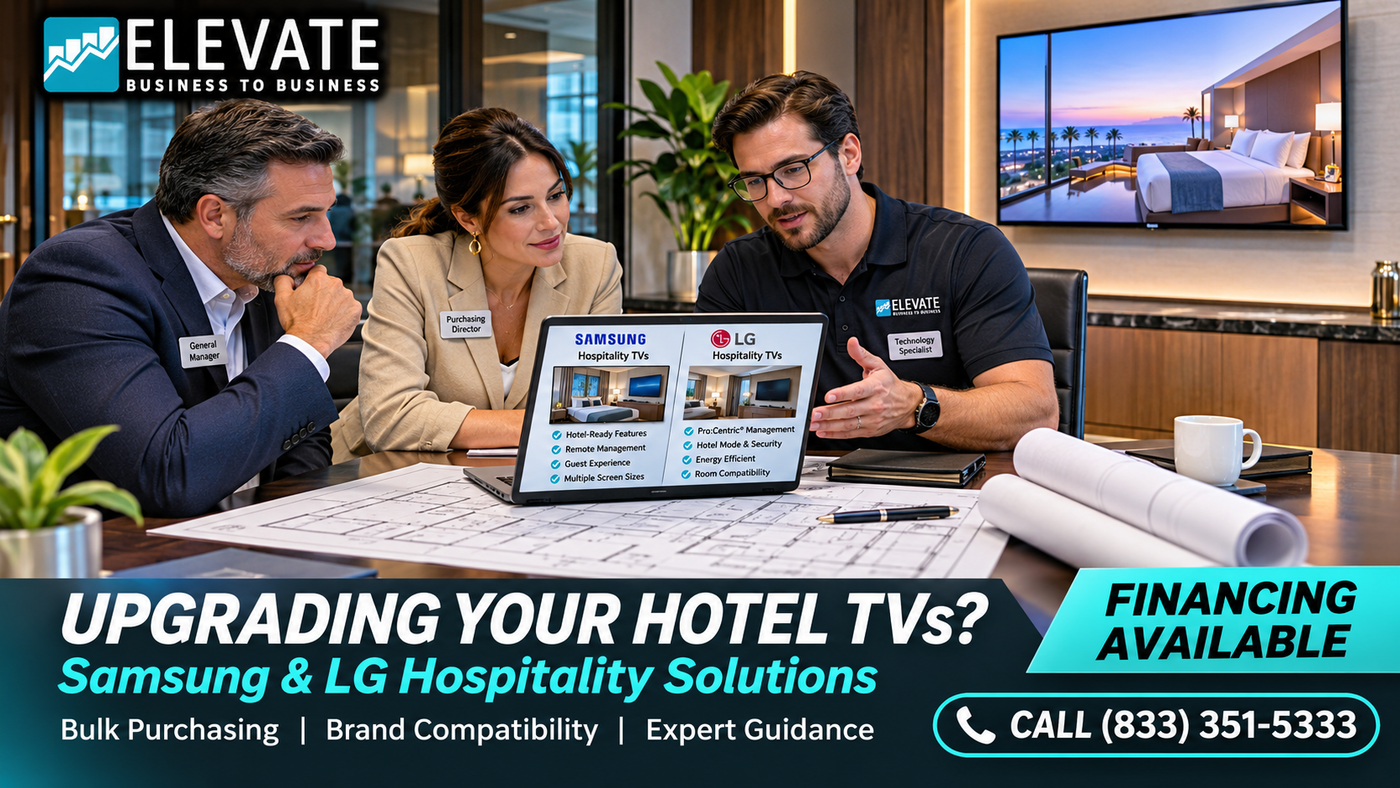
7. Samsung Hospitality TVs vs. LG Hospitality TVs
Samsung and LG are two major manufacturers offering hospitality television solutions.
Both provide commercial product lines intended for hotel environments, but available capabilities differ by series and model.
Samsung Hospitality TVs
Samsung hospitality televisions may offer hotel configuration tools, guest entertainment features, and compatibility with supported hospitality platforms.
Specific Samsung models may support specialized management solutions, commercial content protection, and other hotel-oriented functionality.
Hotel owners interested in these products can review Samsung Hospitality TVs or learn more about the Samsung U701.
LG Hospitality TVs
LG also offers hospitality televisions designed for managed guest-room environments.
Depending on the model and supporting platform, LG televisions can provide hotel settings, content management options, and integration with compatible entertainment systems.
When comparing Samsung and LG, property owners should evaluate actual model specifications rather than choosing based on brand recognition alone.
Important factors include screen sizes, pricing, availability, management capabilities, warranty terms, and system compatibility.
Elevate B2B can help purchasing teams compare suitable equipment for their project.
8. Hotel Brand Standards Matter
Many branded hotels operate under specific technology and property improvement requirements.
Properties affiliated with Marriott, Hilton, IHG, and other hospitality organizations may need televisions compatible with approved entertainment systems or current brand standards.
Examples of brand-related technology environments include Marriott guest-room entertainment requirements, IHG STUDIO, and Hilton Connected Room.
These systems and their requirements should not be treated as interchangeable.
A television that meets one brand’s requirements may not automatically satisfy another brand’s standards.
Requirements can also change by property type, technology program, and renovation cycle.
Hotel owners should verify current specifications with their franchisor or approved technology provider before placing large equipment orders.
Purchasing the wrong television models can result in replacement costs, project delays, or additional integration expenses.
For broader equipment comparisons, review Best Hotel TV Systems.
9. Bulk Hospitality TV Purchasing Can Improve Project Efficiency
Purchasing televisions individually from retail stores may appear convenient, especially for smaller properties.
However, large-scale hotel projects require coordinated planning.
A 150-room renovation may involve multiple screen sizes, mounting configurations, delivery schedules, installation teams, and replacement inventory.
Buying televisions through a commercial hospitality supplier can help streamline procurement.
Elevate B2B provides hospitality equipment sourcing and supply chain solutions designed around commercial purchasing needs.
Depending on project requirements, purchasing support may include coordinating equipment quantities, reviewing compatible products, and planning delivery requirements.
Standardizing televisions across rooms can also simplify staff training and future replacement planning.
For example, a hotel that uses the same television series throughout its property may find it easier to maintain consistent configurations and manage compatible accessories.
The key is choosing a model that meets operational requirements and remains practical to support.
10. Financing Available for Hotel TV Upgrades
One concern hotel owners frequently raise is the upfront cost of replacing dozens or hundreds of televisions.
A large renovation can place pressure on cash flow, especially when televisions are being upgraded alongside furniture, flooring, appliances, and other property improvements.
Financing is available through Elevate B2B, providing hotel operators an option to explore when planning qualifying equipment purchases.
Rather than delaying an entire technology upgrade because of upfront equipment expenses, property owners can investigate financing as part of their purchasing strategy.
Potential reasons to consider financing include preserving working capital, coordinating renovation expenses, and planning equipment upgrades around operating budgets.
Financing should always be evaluated against total borrowing costs, repayment terms, and the property’s financial position.
Visit the Elevate B2B Financing Page to learn more about available options and request information about eligibility and terms.
Financing approval, payment amounts, and availability depend on the applicable program and qualification requirements.
Ready to price your hotel TV project?
Call (833) 351-5333 to discuss equipment selection, project quantities, installation requirements, and financing availability.
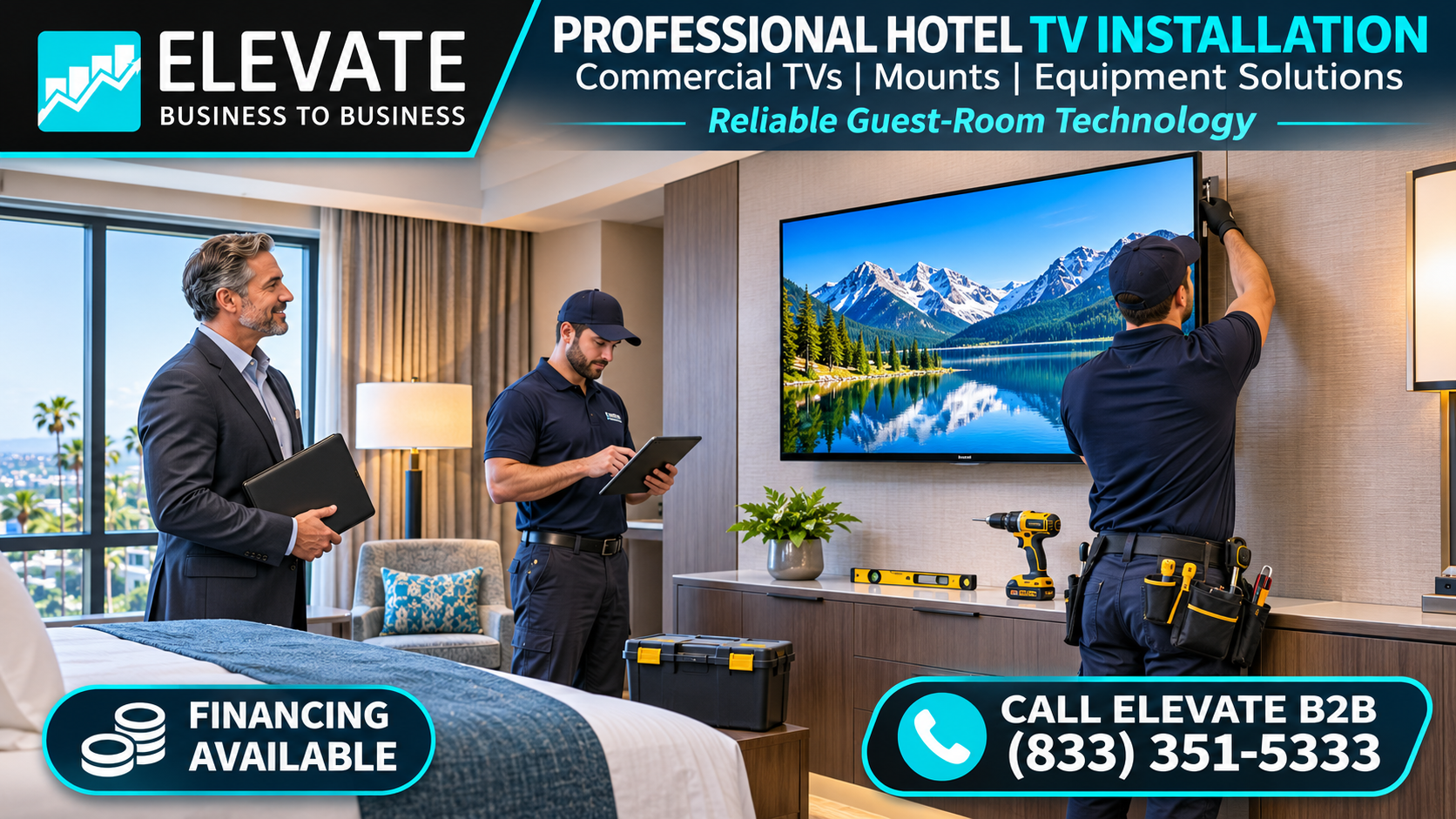
11. Professional Installation Is Part of the Investment
Even the best hospitality television can create problems when installed incorrectly.
Improper mounting, exposed wiring, incorrect configurations, or incompatible equipment can lead to operational difficulties.
Professional installation planning should consider television placement, wall construction, mount compatibility, electrical access, cable routing, network connectivity, and guest accessibility.
Hotel owners should also consider whether installation work can be completed without unnecessarily disrupting occupied rooms.
A well-organized installation project may involve:
- Evaluating existing television equipment and infrastructure.
- Selecting compatible hospitality television models.
- Confirming mounting hardware and accessories.
- Coordinating equipment delivery.
- Installing and configuring televisions.
- Testing functionality before rooms return to service.
Elevate B2B offers installation services and commercial equipment solutions to support hospitality projects.
Professional planning is particularly important when a property is replacing large numbers of televisions within a limited renovation window.
PART 3: Real-World Purchasing Scenarios, FAQs, and Expert Recommendations
12. When Should a Hotel Choose Commercial TVs?
Commercial hospitality televisions are particularly valuable when a property needs consistent room configurations, managed entertainment systems, or specialized integration capabilities.
Consider commercial-grade televisions when:
- Your property operates dozens or hundreds of guest rooms.
- Your hotel requires compatibility with a branded entertainment platform.
- Your staff frequently handles television configuration problems.
- You are replacing televisions during a PIP renovation.
- Your property needs centralized management or restricted guest settings.
- You want standardized equipment across multiple locations.
- Your existing entertainment infrastructure requires specific commercial hardware.
Smaller independent properties may have simpler requirements, but commercial-grade televisions can still provide useful benefits.
The most important question is whether the equipment supports the hotel’s operational needs.
13. When Might Consumer TVs Make Sense?
Consumer televisions are not automatically the wrong choice for every lodging business.
A very small independent property with basic entertainment requirements may find that selected consumer televisions meet its needs.
For example, a four-room bed-and-breakfast without centralized IPTV or franchise technology requirements may have different priorities from a 300-room branded hotel.
However, property owners should verify warranty eligibility for commercial use, compatibility with their television service, and any applicable content licensing requirements.
They should also consider how guest accounts, settings, and technical support will be managed.
A lower purchase price is only a benefit when the equipment meets the property’s actual requirements.
14. Case Study Scenario: A 100-Room Hotel Television Replacement
The following case study is a hypothetical purchasing scenario illustrating how a hotel might evaluate its options. It is not a documented Elevate B2B customer project.
Property: 100-room independent hotel
Challenge: Aging televisions, inconsistent configurations, and recurring guest complaints.
The hotel’s management team is considering replacing all 100 televisions.
The purchasing department initially identifies affordable consumer televisions at a local retailer.
However, the maintenance manager raises concerns about guest setting changes, replacement consistency, and compatibility with the property’s existing channel distribution system.
The hotel decides to compare consumer televisions with commercial hospitality models.
During the evaluation, management reviews initial equipment costs, warranty coverage, configuration requirements, installation expenses, and replacement planning.
Purchasing decision: The hotel selects a compatible commercial hospitality television system because its operational features better match the property’s needs.
Potential operational benefits: More consistent room configurations, simplified equipment standardization, and fewer avoidable configuration-related maintenance requests.
Actual savings would need to be measured after deployment.
Key takeaway: Hotel purchasing decisions should account for operational costs and system compatibility, not simply the lowest advertised television price.
15. Case Study Scenario: A Branded Hotel Preparing for a PIP
This is an illustrative scenario, not a verified customer testimonial.
Property: 180-room branded hotel
Challenge: A property improvement plan requires guest-room technology upgrades.
The hotel’s ownership group wants to modernize televisions while coordinating furniture replacements, room renovations, and other improvements.
The purchasing team identifies several retail television models that appear attractive because of their low prices.
However, further review reveals that the proposed televisions have not been confirmed compatible with the property’s required entertainment platform.
Management decides to verify the current brand standards before purchasing.
The hotel then evaluates approved commercial hospitality models, compatible mounting accessories, delivery schedules, and available financing.
Purchasing decision: The ownership group prioritizes verified compatibility and coordinated procurement rather than purchasing unapproved equipment.
Potential benefits: Reduced risk of buying incompatible televisions, more predictable installation planning, and better alignment with renovation requirements.
Key takeaway: Confirming hotel brand standards before ordering equipment can help prevent expensive purchasing mistakes.
16. Case Study Scenario: A Multi-Property Hotel Operator
This example is hypothetical and is provided for purchasing education.
Property portfolio: Three hotels totaling 350 guest rooms
Challenge: Different television brands and models across properties create inconsistent maintenance and replacement procedures.
Each location purchases replacement televisions independently.
As a result, maintenance teams manage multiple remote-control types, different configuration menus, and varying mounting requirements.
The ownership group begins evaluating a standardized purchasing strategy.
Management compares hospitality television models that meet each property’s requirements and develops a coordinated replacement plan.
The team also reviews spare equipment quantities, remote controls, and installation accessories.
Potential benefits: Simplified procurement, improved equipment consistency, and more organized replacement inventory.
Key takeaway: Standardization can improve operational efficiency, provided the selected equipment meets each property’s individual technology requirements.
17. Why Hotel Owners Work With Elevate B2B
Buying hospitality televisions involves more than selecting a screen size.
Hotel owners need equipment that fits their budgets, supports their entertainment systems, and can be installed and maintained efficiently.
Elevate B2B helps hospitality purchasing teams navigate these decisions.
The company offers Samsung and LG hospitality television options along with complementary commercial equipment and services.
Hotel owners can also explore Hospitality TVs and additional purchasing resources through the Elevate B2B Blog.
Beyond guest-room televisions, Elevate B2B provides commercial equipment solutions that can support broader property improvement projects.
These include commercial displays, television mounts, video walls, and Digital Signage Solutions for hotels and other business environments.
For hotel owners updating additional guest-room equipment, Elevate B2B also offers Hospitality Appliances, including options such as mini refrigerators, microwaves, and other commercial property products.
This makes it possible to discuss multiple equipment requirements as part of a coordinated purchasing plan.

Frequently Asked Questions About Commercial TVs for Hotels
1. Should hotels buy commercial TVs instead of consumer TVs?
For most medium-sized and large hotels, commercial hospitality televisions are generally the better choice because they provide features designed for managed guest-room environments. These may include restricted settings, standardized configurations, and compatibility with hospitality entertainment systems. The final decision should depend on the property’s technology requirements and total ownership costs.
2. What is the difference between a hotel TV and a regular TV?
Hotel televisions are commercial models designed for hospitality use. Depending on the model, they may support hotel configuration modes, welcome screens, volume restrictions, centralized management, and specialized entertainment platforms. Regular consumer televisions focus primarily on residential entertainment.
3. Are commercial hospitality TVs more expensive?
Commercial hospitality televisions can cost more initially than consumer models. However, their operational features may reduce certain maintenance and configuration expenses. Hotel owners should compare total ownership costs, including installation, licensing, warranties, support, and future replacements.
4. Can hotels use regular smart TVs in guest rooms?
Some hotels can use consumer smart TVs, depending on their operating requirements. However, property owners should confirm commercial-use warranty coverage, entertainment system compatibility, guest privacy safeguards, and franchise standards before purchasing.
5. Do Samsung and LG make hospitality televisions?
Yes. Samsung and LG offer commercial hospitality television product lines. Available features vary by model and series. Elevate B2B helps hotel purchasing teams explore Samsung and LG equipment options for their projects.
6. Do hospitality TVs support Netflix and streaming services?
Some hospitality television systems support streaming, casting, or compatible guest entertainment platforms. Availability depends on the television, software, service provider, and licensing. Hotels should verify account privacy and guest-session management rather than relying on ordinary residential streaming applications.
7. Can hotels buy hospitality TVs in bulk?
Yes. Commercial hospitality televisions can be purchased in quantities suitable for hotel renovation, replacement, and new-construction projects. Elevate B2B helps property owners discuss equipment requirements and bulk purchasing options.
8. Do commercial TVs work with hotel IPTV systems?
Many commercial hospitality television models support specific IPTV platforms, but compatibility varies. Hotels should verify television specifications, network requirements, content protection, and platform approval before ordering.
9. Is financing available for hotel TV purchases?
Yes, financing is available through Elevate B2B. Eligibility, approval, rates, and repayment terms depend on the applicable financing program. Visit the Financing Page or call (833) 351-5333 for more information.
10. Where can hotel owners purchase commercial hospitality TVs?
Hotel owners can contact Elevate B2B to discuss commercial hospitality televisions, bulk equipment purchasing, installation requirements, and related products. Call (833) 351-5333 to request a quote.
Final Verdict: Are Commercial TVs Worth It for Hotels?
For most hotels operating multiple guest rooms, commercial hospitality televisions are the stronger long-term purchasing choice when their specialized capabilities match the property’s needs.
While consumer televisions may offer lower upfront prices, commercial models can provide valuable operational advantages.
Features such as restricted settings, consistent configurations, hospitality platform compatibility, and commercial purchasing support can make a meaningful difference across a hotel property.
However, the best investment is not necessarily the most expensive television.
Hotel owners should select equipment based on guest expectations, technology compatibility, brand requirements, warranty coverage, installation needs, and total ownership costs.
A well-planned television replacement project can support better guest experiences while helping hotel staff manage equipment more efficiently.
Elevate B2B Is Here to Help
Whether you are replacing 20 televisions at an independent hotel or planning a large-scale renovation across multiple properties, Elevate B2B can help you explore suitable commercial hospitality television solutions.
Our product offerings include Samsung and LG hospitality televisions, commercial displays, mounting accessories, and related hotel equipment.
Financing is available for qualifying projects, and our team can help you review equipment options and purchasing requirements.
Stop guessing which televisions are right for your hotel.
Call Elevate B2B today at (833) 351-5333 to request competitive project pricing, discuss your renovation, or explore available financing options.
You can also visit Elevate B2B to contact the team or book an appointment online.
Make your next hotel TV purchase a smarter investment. Contact Elevate B2B today.
