
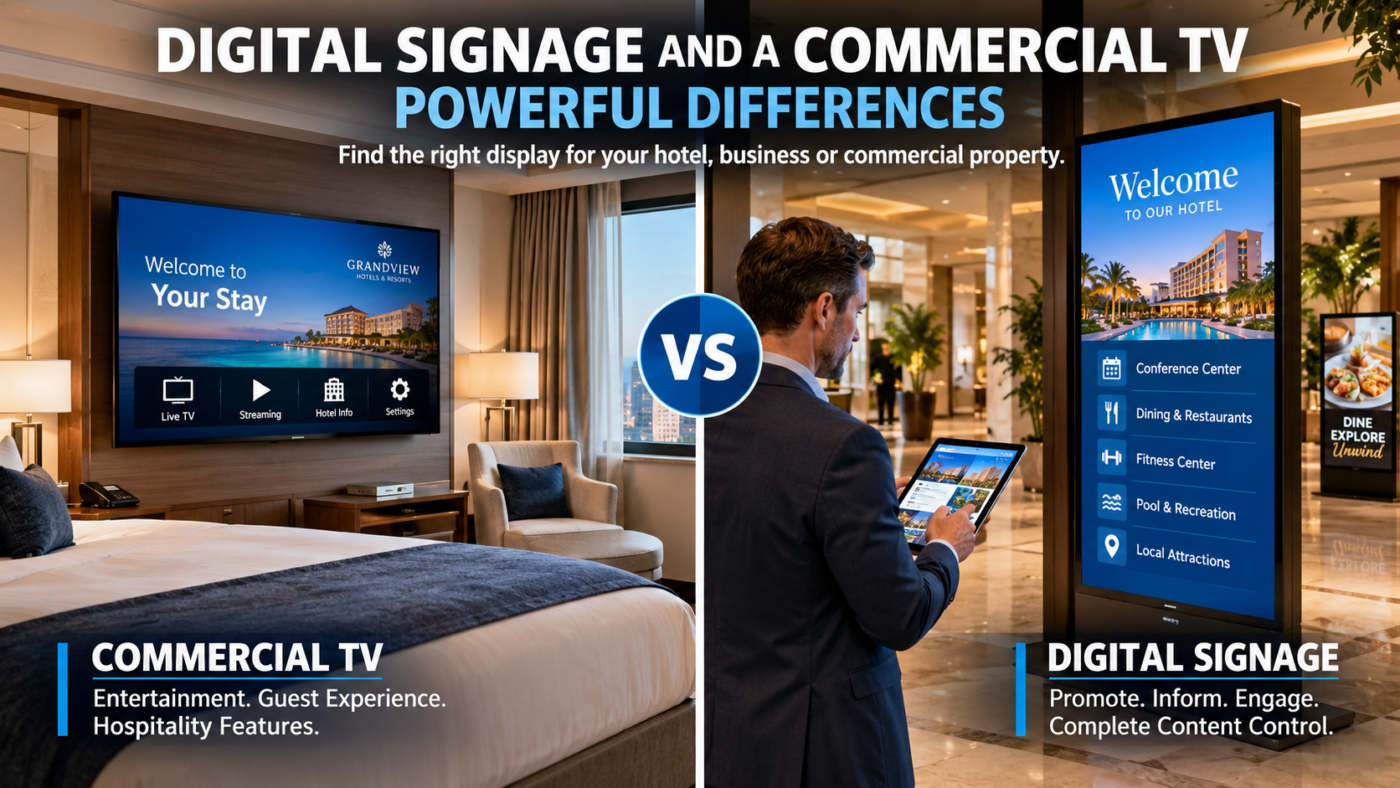
If you are upgrading a hotel, casino, healthcare facility, restaurant, conference center, or other commercial property, you may find yourself asking a surprisingly important question: What is the difference between digital signage and a commercial TV?
At first glance, they can look nearly identical. Both may offer a large 4K screen, HDMI connectivity, network capabilities, wall-mounting options, and a professional appearance. But they are designed for different purposes.
A commercial TV is generally built around television viewing, hospitality entertainment, or business presentation applications. Digital signage is designed primarily to communicate information, advertising, branding, wayfinding, promotions, menus, schedules, and other controlled content to an audience.
That distinction becomes extremely important when a business is buying dozens—or even hundreds—of displays.
Choosing the wrong type of display can mean paying for capabilities you do not need or, worse, installing equipment that does not properly support how the screens will actually be used.
Elevate B2B helps businesses evaluate these requirements before purchasing equipment. We provide commercial TVs, hospitality TVs, digital signage, interactive displays, outdoor displays, video walls, mounts, installation services, supply-chain solutions and other commercial technology nationwide.
If you are trying to determine whether your project needs digital signage and a commercial TV, or a combination of both, Elevate B2B is here to help. You can easily book an appointment online or call (833) 351-5333.
Table of Contents
Understanding Digital Signage and Commercial TVs
What Is Digital Signage?
Digital signage is a professional visual communication system designed to deliver controlled digital content to customers, guests, patients, employees or visitors.
Instead of printing a poster every time information changes, a business can use digital signage to display and update content electronically.
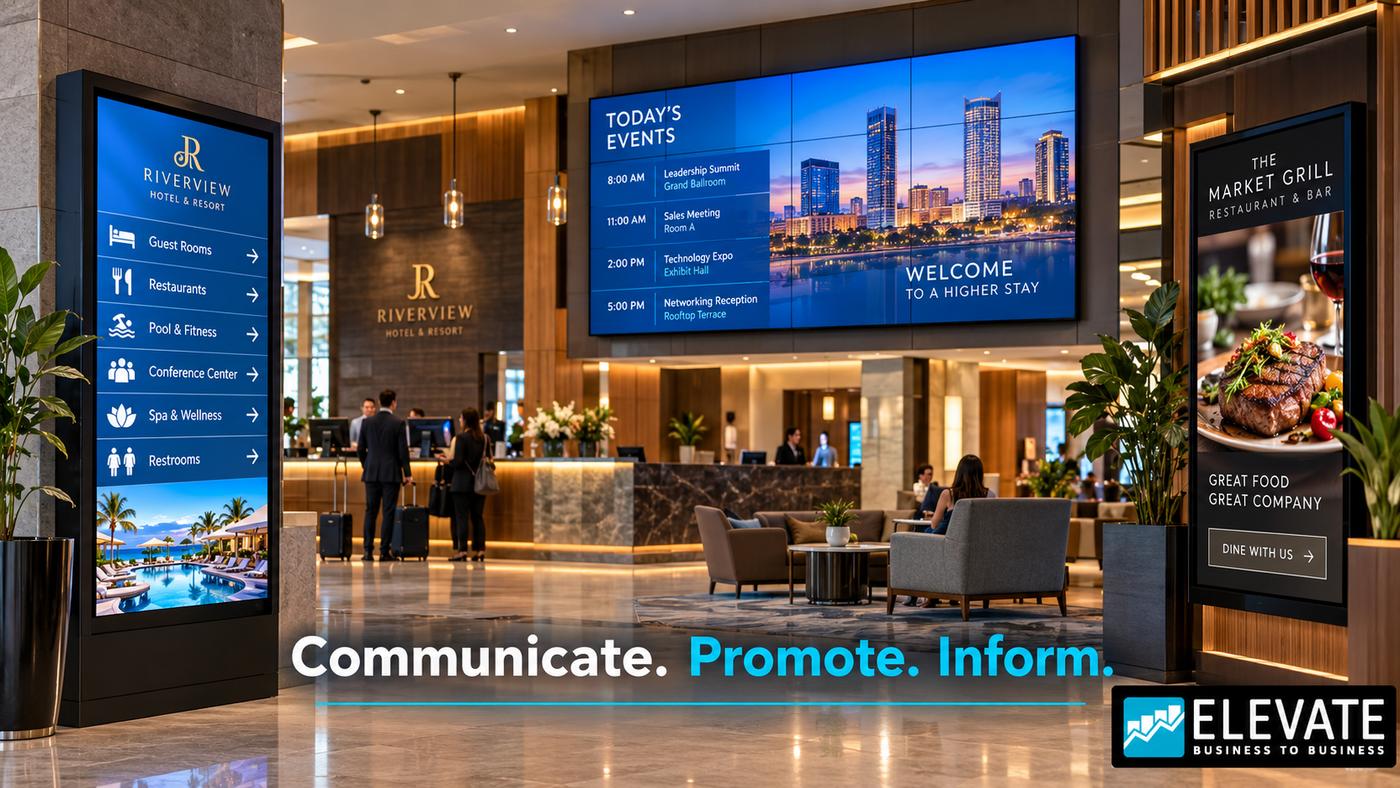
Digital signage can be used for advertising, menus, directories, promotions, wayfinding, event schedules, conference information, employee communications, emergency messaging, hotel amenities, casino promotions and branding.
A hotel, for example, could place a digital display near its conference center and use it to show that day’s meetings. Later, the same display could promote the hotel’s restaurant, advertise happy hour, provide directions to the ballroom or welcome a corporate group.
That flexibility is one of the major advantages of digital signage.
Businesses considering this technology can explore Elevate B2B’s Digital Signage solutions to see how commercial displays can be incorporated into a larger communication strategy.
What Is a Commercial TV?
A commercial TV is a television engineered for business or professional applications rather than ordinary residential use.
Depending on the model and application, commercial televisions may offer features such as stronger device management, commercial warranties, configurable settings, cloning capabilities, hospitality functionality, centralized control, security settings and compatibility with commercial entertainment systems.
For hotels, the distinction becomes even more specific.
Hospitality TVs are designed for guest-room environments where properties may need welcome screens, controlled settings, channel configurations, hotel information, property branding, IPTV compatibility and other hospitality-specific functions.
If guest-room entertainment is the primary objective, start with Elevate B2B’s Hospitality TV solutions and the Guide to Hospitality TVs.
The Simplest Way to Understand the Difference
Think about the purpose of the screen.
If the primary purpose is for a guest, patient or customer to watch television or entertainment, you are probably looking at a commercial or hospitality TV application.
If the primary purpose is for the business to control what the audience sees, you are probably looking at a digital signage application.
A hotel guest-room TV is primarily there for the guest.
A hotel lobby signage display is primarily there for the hotel.
That is the fundamental difference.
Digital Signage vs. Commercial TV Comparison
| Feature | Digital Signage | Commercial TV |
|---|---|---|
| Primary purpose | Business messaging and visual communication | Television and entertainment |
| Typical content | Promotions, menus, schedules, wayfinding, branding | TV channels, streaming, entertainment |
| Content scheduling | Common | Not usually the primary purpose |
| Centralized content management | Often important | Depends on system/model |
| Portrait orientation | Available on appropriate signage models | Usually landscape-focused |
| Guest-room use | Usually unnecessary | Excellent with hospitality models |
| Lobby advertising | Excellent | Possible, but often not ideal |
| Conference schedules | Excellent | Limited without added systems |
| Digital menu boards | Excellent | Not the preferred application |
| Hotel entertainment | Secondary use | Primary use |
| Outdoor applications | Available with specialized displays | Generally not intended for this |
| Video wall applications | Specialized models available | Usually not the best choice |
| Interactive applications | Available with touch displays | Generally limited |
The important point is that digital signage and a commercial TV are not automatically interchangeable simply because they have similar screen sizes and resolutions.
Why Not Just Buy the Cheapest Screen?
This is where commercial buyers can make an expensive mistake.
Purchase price is only one part of total project cost.
Businesses also need to consider operating hours, brightness, content management, mounting orientation, warranty terms, installation requirements, expected lifespan, control requirements and future expansion.
If a lobby display needs to run promotional content for extended periods every day, the cheapest TV on the shelf may not be the right solution.
Likewise, installing an advanced digital signage display in every hotel guest room may add capabilities and costs that are unnecessary when the real objective is guest entertainment.
The correct approach is matching the hardware to the application.
Elevate B2B’s article on Digital Signage Hardware goes deeper into selecting commercial display hardware for hotels, healthcare facilities, restaurants, casinos and other commercial environments.
PART 2: Which Display Is Right for Your Business?
When Digital Signage Is the Better Choice
Digital signage becomes the stronger choice when the display itself is part of your communication or marketing strategy.
Imagine a hotel with five meetings taking place during the same day.
Instead of printing signs for each meeting room, employees can update digital displays with event names, times and directions. When an event ends, the content can change without replacing a single printed sign.
Now consider a hotel restaurant.
Breakfast specials can appear in the morning. Lunch promotions can automatically replace them later. Happy-hour advertising can run in the afternoon, followed by dinner promotions that evening.
The same physical display can support multiple business objectives throughout the day.
That is where digital signage becomes much more than a television hanging on a wall.
Elevate B2B’s guide to Commercial Digital Signage for Hotels explores how properties can use displays for lobby communication, conference information, menus and wayfinding.
When a Commercial or Hospitality TV Is Better
Commercial TVs become the logical choice when entertainment is the priority.
Hotel guest rooms are the obvious example.
Guests expect an intuitive television experience. They want to turn on the TV, navigate channels, access available entertainment and enjoy high-quality video without dealing with complicated controls.
The hotel, meanwhile, may need more control than a residential television provides.
Hospitality television systems can support property-specific requirements and help hotels standardize equipment across dozens or hundreds of rooms.
Hotels planning larger purchases should also read Elevate B2B’s Hospitality TV Procurement guide before choosing models and quantities.
Can a Commercial TV Be Used for Digital Signage?
Sometimes, yes.
But the more important question is whether it should be.
A commercial television can display promotional material when connected to an appropriate content source. For a basic application where a screen only needs to show a simple presentation periodically, that may be sufficient.
However, demanding signage applications may require features better suited to dedicated commercial signage displays.
Think about the operating environment.
Does the screen need to run for long periods?
Will it be mounted vertically?
Does it need high brightness?
Will content be updated remotely?
Will multiple displays need coordinated content?
Will the screen become part of a video wall?
Will it be installed outdoors?
Does the company need centralized scheduling?
Those questions should influence the buying decision far more than simply asking which display costs less.
Brightness and Environment Matter
A screen that looks outstanding inside a dark guest room may perform very differently in a bright hotel lobby with floor-to-ceiling windows.
Ambient light is an important consideration when selecting commercial displays.
Digital signage products are available for a wide range of environments, including high-brightness and outdoor applications. Elevate B2B supplies digital signage products from manufacturers including Samsung, LG, NEC, Philips and Sharp, along with outdoor displays, touch displays, stands and video-wall solutions.
The display needs to be selected for the actual location where it will operate.
Digital Signage in Hotels
Hotels are one of the best examples of why both technologies frequently belong in the same property.
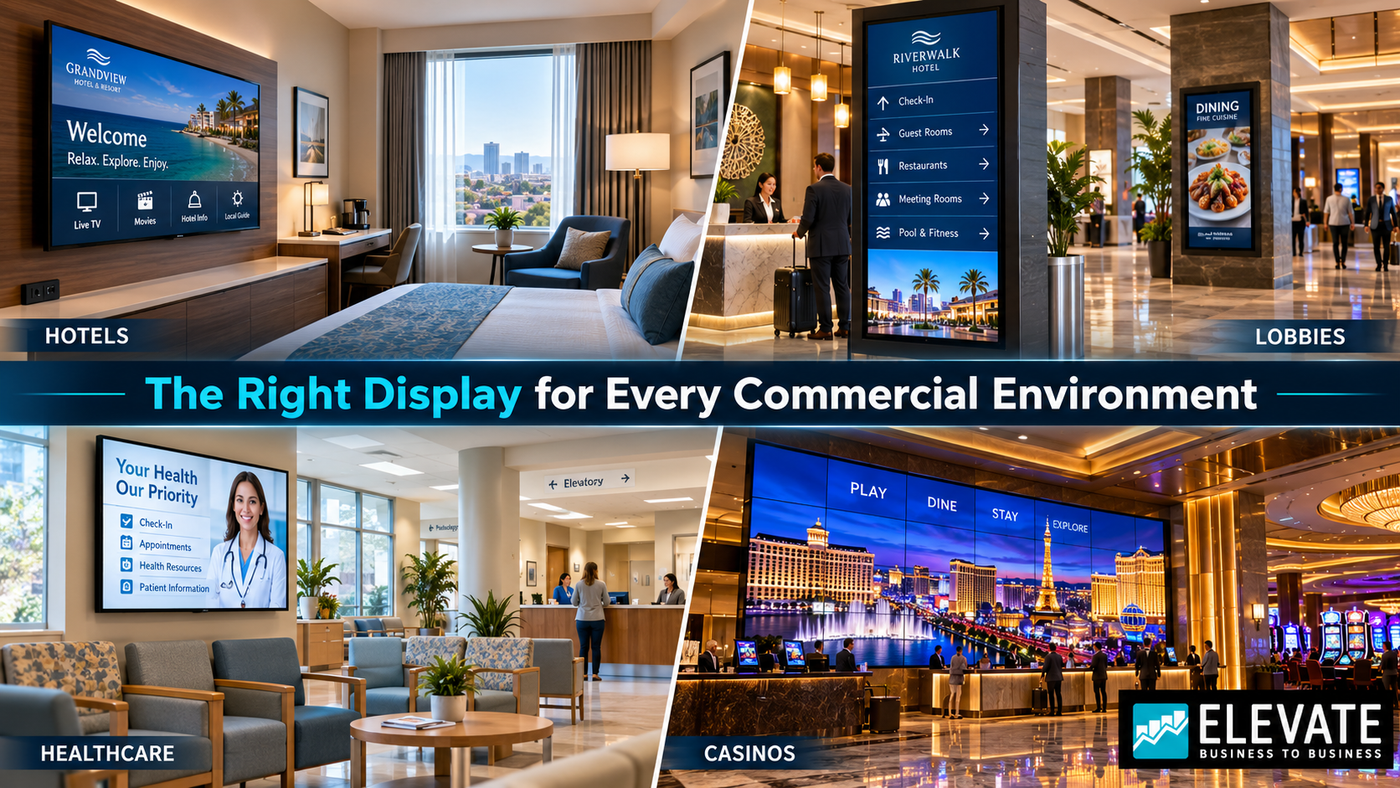
A hotel might use commercial hospitality TVs inside guest rooms while simultaneously deploying digital signage in the lobby, conference center, restaurant, fitness center and other common areas.
That creates a connected visual environment without trying to force one display type to perform every task.
Hotels interested in developing a broader technology strategy can review Elevate B2B’s Hospitality AV Solutions guide.
Digital Signage in Healthcare
Healthcare environments can use digital signage for directories, patient information, educational messaging, waiting-room communications and wayfinding.
Patient rooms, however, may have completely different requirements.
That is why healthcare TV models exist. A display selected for a hospital room and a display selected for a hospital lobby directory solve different problems, even though both may look like televisions.
Digital Signage in Casinos
Casinos represent another environment where commercial displays can have multiple roles.
Digital signage may advertise restaurants, entertainment, promotions, loyalty programs or property information. Large-format displays and video walls can create high-impact visual experiences.
Hotel rooms within the same casino resort may use hospitality TVs instead.
For particularly large visual installations, Elevate B2B’s guide to Hospitality Video Wall Solutions explains how video walls can fit into hotels, casinos and commercial properties.
PART 3: Planning a Smarter Commercial Display Project
The Five Questions to Ask Before Buying
Before requesting pricing, determine the primary purpose of each screen, expected daily operating hours, physical environment, content requirements and how the system will be managed.
These questions can prevent a business from purchasing hundreds of screens based primarily on screen size and price.
For example, a 55-inch television and a 55-inch signage display may appear similar on a specification sheet, but they could have very different intended applications.
The better procurement question is not:
“Which 55-inch screen is cheaper?”
It is:
“Which 55-inch screen is designed for what we need this location to accomplish?”
That change in thinking can improve the entire project.
Do Not Forget the Mounting System
Choosing the correct screen is only part of a commercial installation.
The mounting solution matters too.
Elevate B2B offers flat mounts, full-motion and articulating mounts, pivot mounts, press-and-release solutions, pull-out pivot mounts, swivel stands, tilt mounts, whiteboard mounts and mounting accessories.
A lobby display, video wall and hotel guest-room television may each require a different mounting strategy.
Installation planning should consider viewing height, accessibility, cable management, serviceability, wall construction, screen orientation and the ability to replace or service equipment later.
Case Study Scenario #1: Hotel Renovation
Consider a hotel renovating 150 guest rooms while also modernizing its lobby and meeting spaces.
Purchasing the same display for every location may seem like the easiest procurement strategy, but it ignores how the screens will actually be used.
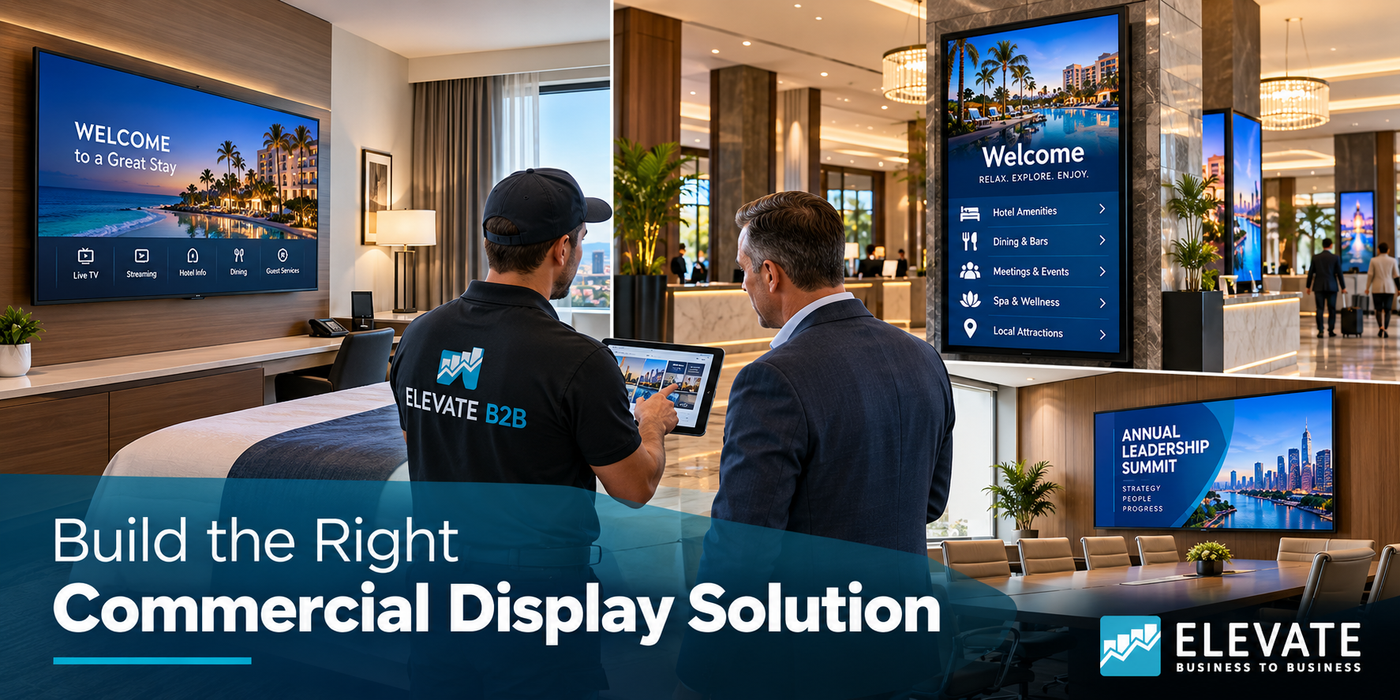
A more targeted approach could use hospitality TVs in the guest rooms, commercial digital signage in the lobby, scheduling displays near conference rooms and larger commercial displays in meeting spaces.
Now every screen is selected for its job.
The guest-room TVs focus on entertainment.
The lobby displays focus on communication and promotion.
The meeting-area displays help guests navigate events.
The property gains a more unified technology experience without overbuying unnecessary capabilities.
Case Study Scenario #2: Multi-Property Hotel Group
Now consider a hotel group upgrading several properties.
The purchasing team may need consistent models, coordinated delivery schedules, commercial mounting hardware and a plan for installation across different locations.
Standardization becomes important—but standardization does not mean using the exact same product everywhere.
Instead, the company can standardize by application.
One hospitality TV family might be used across guest rooms, while a commercial signage family is standardized across lobby and meeting-area applications.
This approach can simplify purchasing and maintenance while still matching each display to its purpose.
For buyers considering volume orders, Elevate B2B provides bulk hospitality TV solutions for hotel, chain and casino projects.
Case Study Scenario #3: Existing Digital Signage Upgrade
A business with aging screens may not necessarily need to replace every part of its existing system.
Depending on existing infrastructure and compatibility, a retrofit strategy may allow the property to modernize displays, mounts, players or management technology while retaining useful infrastructure.
Elevate B2B’s Digital Signage Retrofit guide discusses this approach in more detail.
The important step is evaluating what can remain and what is limiting the current system.
Financing Is Available for Commercial Projects
Large display projects can represent a significant capital investment, especially when televisions, digital signage, mounts, installation, shipping and other project expenses are being purchased together.
Elevate B2B offers commercial financing options through Ascentium Capital.
Current financing options include financing and leasing up to $2 million, application-only financing up to $250,000, $0-down and deferred-payment options, fast credit decisions and broad terms. Eligible projects may also be able to bundle expenses such as shipping and tax through 100% financing, helping reduce initial out-of-pocket expenses.
Financing is subject to credit approval, documentation requirements and applicable terms. Potential tax benefits vary, so businesses should consult their tax advisor regarding their specific situation.
Learn more about available options on the Elevate B2B Commercial Financing page.
Why Work With Elevate B2B?
Commercial technology procurement involves much more than choosing a screen from a catalog.
The real project may involve TVs, digital signage, mounting hardware, installation, content requirements, logistics, accessories, multiple locations and delivery deadlines.
Elevate B2B works with hotels, casinos, healthcare organizations and commercial businesses to help identify appropriate technology for each application.
Our product and service capabilities include hospitality TVs, commercial displays, digital signage, outdoor displays, interactive displays, Samsung video walls, commercial TV mounts, installation services, supply-chain solutions, Rescue Delivery and TV accessories.
Instead of asking whether you should buy a TV or signage screen based solely on price, talk with a team that understands how these products are actually used in commercial environments.
Call Elevate B2B today at (833) 351-5333 or book an appointment online to discuss your project.
Frequently Asked Questions
What is the main difference between digital signage and a commercial TV?
The biggest difference is the intended application. Digital signage is primarily designed for controlled business communication such as advertising, menus, wayfinding, schedules, branding and announcements. Commercial TVs are generally designed around television, entertainment and professional viewing applications.
Can I use a commercial TV for digital signage?
A commercial TV can display signage content in certain applications, but that does not mean it is the best solution for every signage project. Operating hours, brightness, orientation, remote management, content scheduling and installation environment should all be considered.
Can digital signage play regular television?
Some digital signage configurations can display video feeds or television content when paired with appropriate equipment and sources. However, if television entertainment is the primary purpose, a commercial or hospitality television may be a more appropriate choice.
Should hotels use digital signage or hospitality TVs?
Most larger hotels can benefit from both. Hospitality TVs are typically appropriate for guest rooms, while digital signage can be used in lobbies, meeting areas, restaurants, conference spaces, elevators and other public areas.
Is digital signage better for hotel lobbies?
Digital signage is often an excellent choice for hotel lobbies because content can be used for welcome messaging, property information, promotions, conference schedules, wayfinding and other guest communications.
What type of display should be used outdoors?
Outdoor environments should use commercial displays specifically designed for the operating conditions of the installation. Brightness, weather exposure, temperature and mounting location should all be considered before selecting equipment.
Does Elevate B2B offer Samsung and LG commercial displays?
Elevate B2B supplies hospitality TVs and commercial display solutions from major manufacturers. Digital signage offerings include brands such as Samsung, LG, NEC, Philips and Sharp, while hospitality TV solutions include Samsung and LG.
Does Elevate B2B provide installation?
Yes. Elevate B2B provides installation services in addition to equipment, mounts, accessories, supply-chain solutions and Rescue Delivery services. Proper installation planning is especially important for large commercial deployments.
Can Elevate B2B help with multi-property projects?
Elevate B2B works with commercial and hospitality projects where equipment, logistics and installation may need to be coordinated across multiple locations. Contact the team with quantities, locations, preferred sizes and project timing to discuss requirements.
Is financing available for digital signage and commercial TV projects?
Yes. Commercial financing is available through Elevate B2B’s financing partner, subject to approval and applicable terms. Financing and leasing options currently extend up to $2 million, with application-only financing available up to $250,000.
Digital Signage or Commercial TV? Start With the Application
The difference between digital signage and a commercial TV becomes much easier to understand once you stop comparing only the screens and start comparing their jobs.
Commercial and hospitality TVs are designed around viewing and entertainment.
Digital signage is designed around communication.
In many commercial properties, the best solution is not choosing one over the other. It is creating a system in which each technology is used where it provides the greatest value.
A hotel may need hospitality TVs in 200 guest rooms, digital signage in the lobby, conference displays near ballrooms, an outdoor display near the entrance and a video wall in a premium common area.
Those screens do not all have the same job, so they should not automatically be the same product.
Elevate B2B can help you determine the right combination of commercial TVs, hospitality TVs, digital signage, mounts, video walls, accessories, installation and logistics for your project.
Whether you are replacing a few aging displays or planning a nationwide multi-property rollout, getting the equipment right at the beginning can reduce unnecessary costs and create a stronger long-term technology strategy.
Elevate B2B is here to help. You can easily book an appointment online or call (833) 351-5333 today to discuss your commercial TV or digital signage project.
