
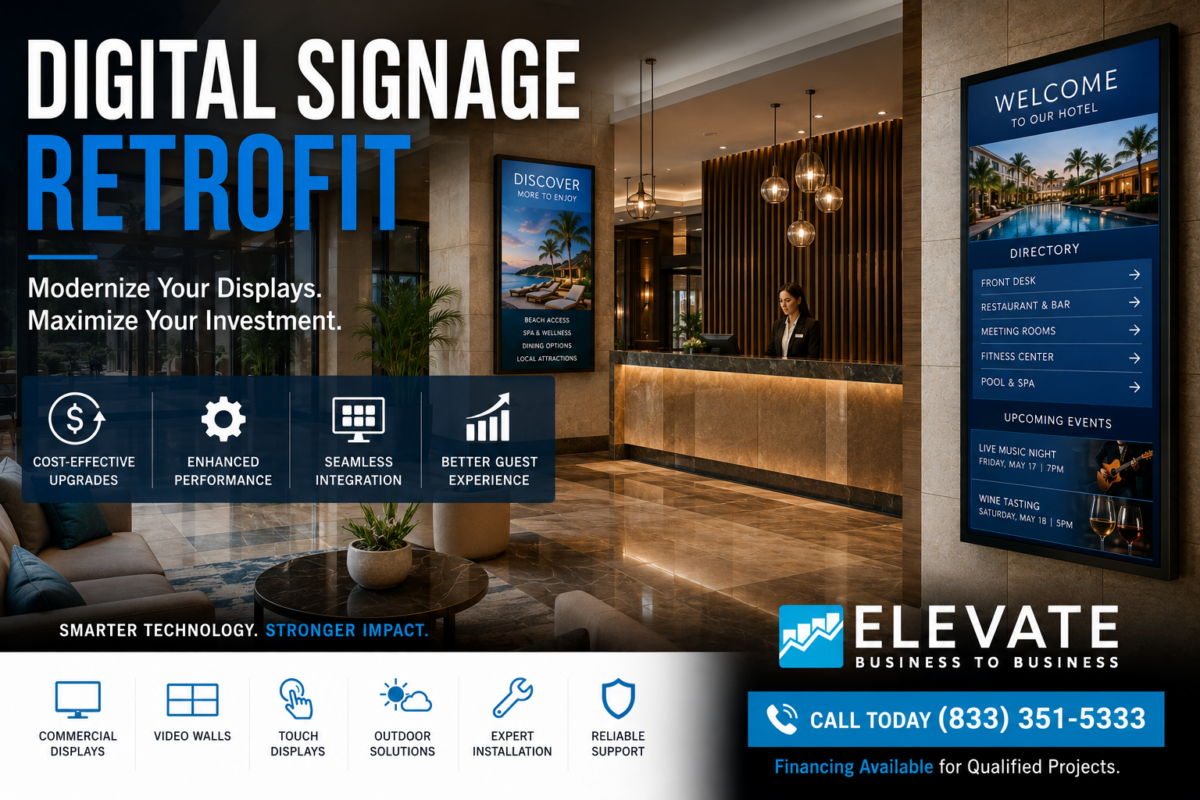
Replacing an outdated digital signage system does not always mean tearing everything out and starting over. For hotels, casinos, healthcare facilities, restaurants, retail environments, and commercial properties, a digital signage retrofit can provide a practical path to better displays, improved content management, higher brightness, stronger reliability, and a more modern customer experience while taking advantage of infrastructure that may already be in place.
A properly planned retrofit can replace aging displays, upgrade media players, improve mounting systems, modernize video walls, add interactive displays, and help businesses transition from outdated signage technology to current commercial display solutions.
That is especially important for hospitality properties.
Guests now encounter digital displays throughout the customer journey—from the moment they enter a hotel lobby to conference areas, restaurants, elevators, meeting rooms, casinos, fitness centers, and other common areas. An outdated screen, burned-in display, unreliable media player, or poorly positioned television can immediately make a renovated property feel older than it really is.
Elevate B2B helps hotels and commercial organizations evaluate digital signage, commercial displays, hospitality TVs, video walls, mounting hardware, and related technology for new installations and retrofit projects.
Financing is available for qualified projects, helping properties spread the cost of a technology upgrade rather than allowing an aging signage system to remain in service simply because replacing everything at once creates a large capital expense.
To discuss your digital signage retrofit project, contact Elevate B2B or call (833) 351-5333.
Learn more about Elevate B2B digital signage solutions.
Table of Contents
Why Digital Signage Retrofit Projects Are Becoming More Important
A digital signage network that looked impressive several years ago may no longer meet the expectations of today’s guests, customers, employees, or property managers.
Displays age. Brightness declines. Connectivity standards change. Content-management requirements evolve. Older mounting systems may limit screen choices. Media players become outdated. Bezels that once looked acceptable can make a video wall appear dated next to newer commercial display technology.
The problem is that many organizations have already invested significant money in their signage infrastructure.
They may already have electrical service, network connections, wall reinforcement, cable pathways, mounts, recessed areas, signage locations, and other components installed throughout the property.
That creates an important question:
Do you really need to replace everything?
Not necessarily.
A digital signage retrofit starts by determining what can remain, what needs to be replaced, and what should be upgraded to support the property’s current objectives.
What Is a Digital Signage Retrofit?
A digital signage retrofit is the process of modernizing an existing digital signage installation using some or all of the property’s existing infrastructure.
Depending on the installation, this may involve:
- Replacing older commercial displays
- Upgrading consumer TVs to commercial-grade displays
- Installing brighter screens
- Replacing media players
- Updating mounting hardware
- Changing display orientation
- Improving cable management
- Modernizing video walls
- Adding touch displays
- Adding outdoor-rated displays
- Upgrading content-management capabilities
- Replacing failing screens without redesigning the entire location
- Standardizing displays across multiple locations
The objective should not simply be to install newer screens.
The objective is to create a more effective signage system while avoiding unnecessary replacement costs wherever possible.
Why Hotels Are Strong Candidates for Digital Signage Retrofits
Hotels continuously renovate.
Guest rooms are refreshed. Lobbies are redesigned. Restaurants change concepts. Meeting spaces receive new technology. Front desks are modernized. Public areas are updated to match current brand standards.
Digital signage needs to evolve alongside those renovations.
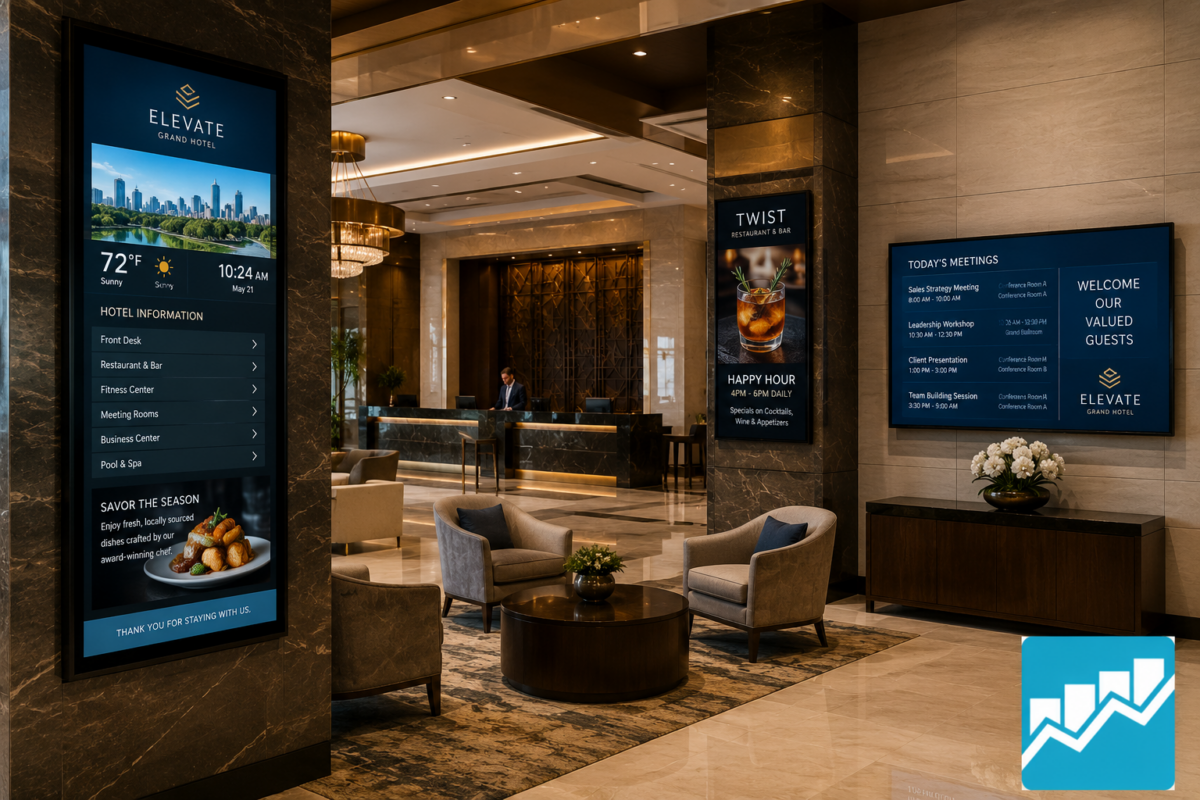
Consider a hotel that installed lobby displays eight years ago. The mounting locations may still be excellent. Electrical connections may already be available. Network cabling may already reach the displays.
But the screens themselves may now have poor brightness, thick bezels, limited connectivity, inconsistent color, or outdated content-management technology.
Instead of rebuilding the entire installation, the hotel may be able to retrofit newer commercial displays into the existing environment.
The result can be a dramatic visual improvement without unnecessarily rebuilding infrastructure that continues to work.
Retrofit Commercial Displays Instead of Using Consumer TVs
One mistake businesses sometimes make is assuming that any television can serve as a digital signage display.
A consumer television may look attractive initially, particularly when comparing purchase prices, but commercial environments have different operating requirements.
Digital signage may operate for extended periods every day. Displays may show menus, directories, advertising, branding, event information, dashboards, wayfinding, promotions, or other business content.
Commercial displays are designed specifically for these types of environments.
Elevate B2B works with digital signage products from manufacturers including Samsung, LG, NEC, Philips, and Sharp, allowing businesses to evaluate commercial display options based on the actual application rather than attempting to force one screen type into every location.
Properties considering a larger hospitality technology upgrade can also review the Elevate B2B Guide to Hospitality TV.
How to Plan a Successful Digital Signage Retrofit
A successful digital signage retrofit begins before the first display is removed from the wall.
The existing system needs to be evaluated.
For a single-screen installation, that assessment may be relatively simple. For a hotel, casino, hospital, resort, or multi-location commercial operation, planning becomes significantly more important.
Step 1: Inventory Your Existing Digital Signage
Start by identifying exactly what is currently installed.
Document:
- Display manufacturer
- Model number
- Screen size
- Display orientation
- Mount type
- Approximate installation date
- Operating hours
- Media player
- Content source
- Network connection
- Cable type
- Available electrical service
- Current screen brightness
- Existing problems
Photos of each installation can also be extremely useful when planning replacement equipment.
For multi-property organizations, creating a standardized inventory can make future procurement considerably easier.
Step 2: Determine Why the Existing System Needs to Change
Do not replace technology simply because it is old.
Identify the business problem.
Perhaps the displays are too dim.
Maybe several screens are failing.
Perhaps content cannot be managed remotely.
Maybe the property completed a multimillion-dollar renovation, but the old displays now look noticeably dated.
Other common reasons include inconsistent screen sizes, poor reliability, outdated inputs, thick bezels, insufficient brightness, difficult content updates, mounting problems, or expansion of the signage network.
Understanding the problem helps determine the right solution.
Step 3: Evaluate the Existing Mounting System
The display itself is only part of a digital signage installation.
Mounting hardware deserves equal attention during a retrofit.
Elevate B2B supplies multiple mounting configurations, including:
- Flat mounts
- Full-motion and articulating mounts
- Pivot mounts
- Press-and-release mounts
- Pull-out pivot mounts
- Swivel stands
- Tilt mounts
- Whiteboard mounts
- Mount accessories
Existing mounts may sometimes be reusable, but compatibility should never simply be assumed.
Display dimensions, weight, VESA mounting patterns, orientation, access requirements, wall construction, and serviceability should all be evaluated.
A retrofit is also an opportunity to correct installations that are difficult to service.
A screen that looks great but requires an unreasonable amount of labor every time someone needs access behind it is not an ideal commercial installation.
Step 4: Select the Correct Brightness for the Environment
Brightness requirements vary dramatically depending on where the screen will operate.
A display installed inside a darker conference area has different requirements than one positioned near large lobby windows.
Outdoor displays create another category entirely.
Choosing based solely on screen size and price can result in a display that looks good on a specification sheet but performs poorly after installation.
A retrofit should consider ambient lighting, viewing distance, operating schedule, content type, reflections, and the location of windows and artificial lighting.
Step 5: Consider Digital Signage Content Management
Hardware gets most of the attention during a signage upgrade, but content management determines how useful the network becomes after installation.
Ask practical questions:
How frequently does content change?
Who controls it?
Does corporate control every display?
Do individual properties need permission to update local information?
Can scheduled content expire automatically?
Does the organization need different content across different locations?
Can displays be monitored remotely?
These questions become particularly important for hotel groups and multi-location commercial operations.
The best-looking display in the world provides limited value if managing the content becomes unnecessarily complicated.
Step 6: Consider a Video Wall Retrofit
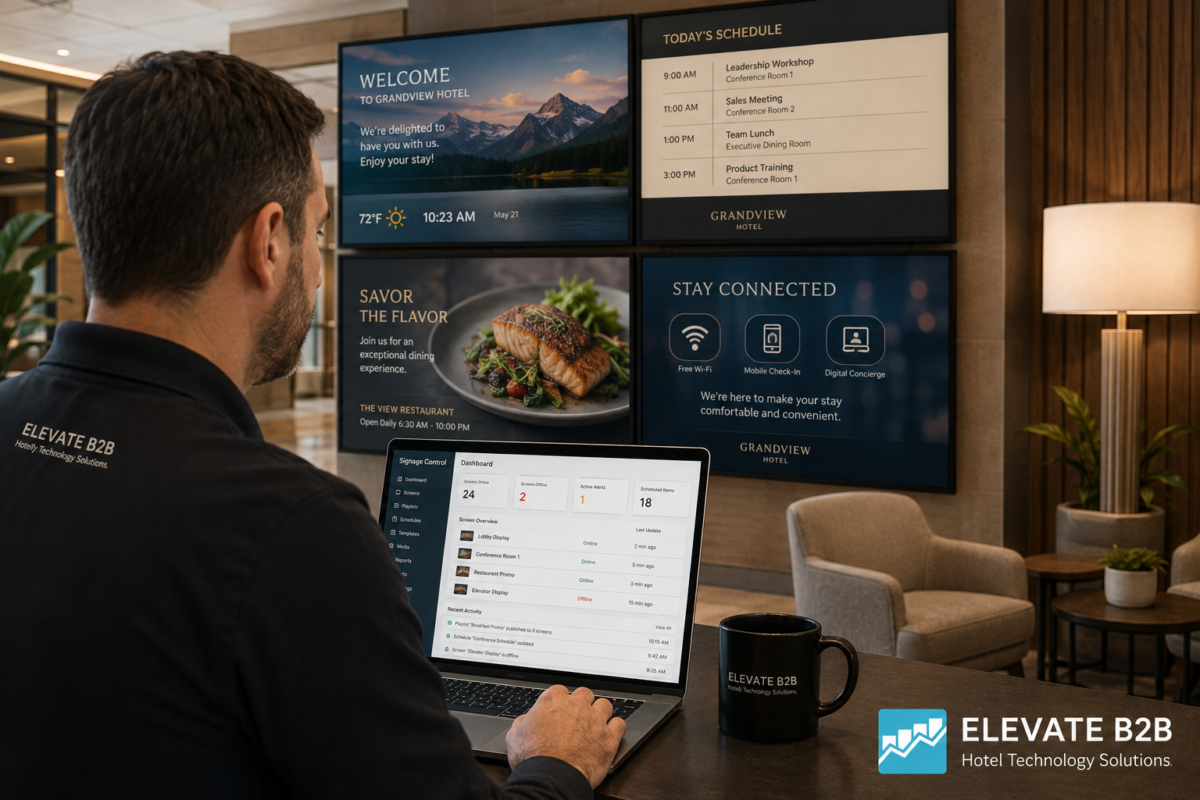
Video walls create some of the most dramatic retrofit opportunities.
Older video walls can quickly reveal their age because the viewer sees multiple displays together.
Differences in brightness, color, alignment, or bezel appearance become more noticeable across a large visual canvas.
A modern video wall can transform:
- Hotel lobbies
- Casino environments
- Conference centers
- Corporate offices
- Entertainment venues
- Retail environments
- Command centers
- Healthcare facilities
Elevate B2B offers Samsung video wall solutions for commercial applications.
A retrofit assessment should determine whether the existing mounting structure and infrastructure can support the planned replacement configuration.
Step 7: Look Beyond the Lobby
Hotel digital signage does not need to stop at the entrance.
Retrofit opportunities may exist throughout the property.
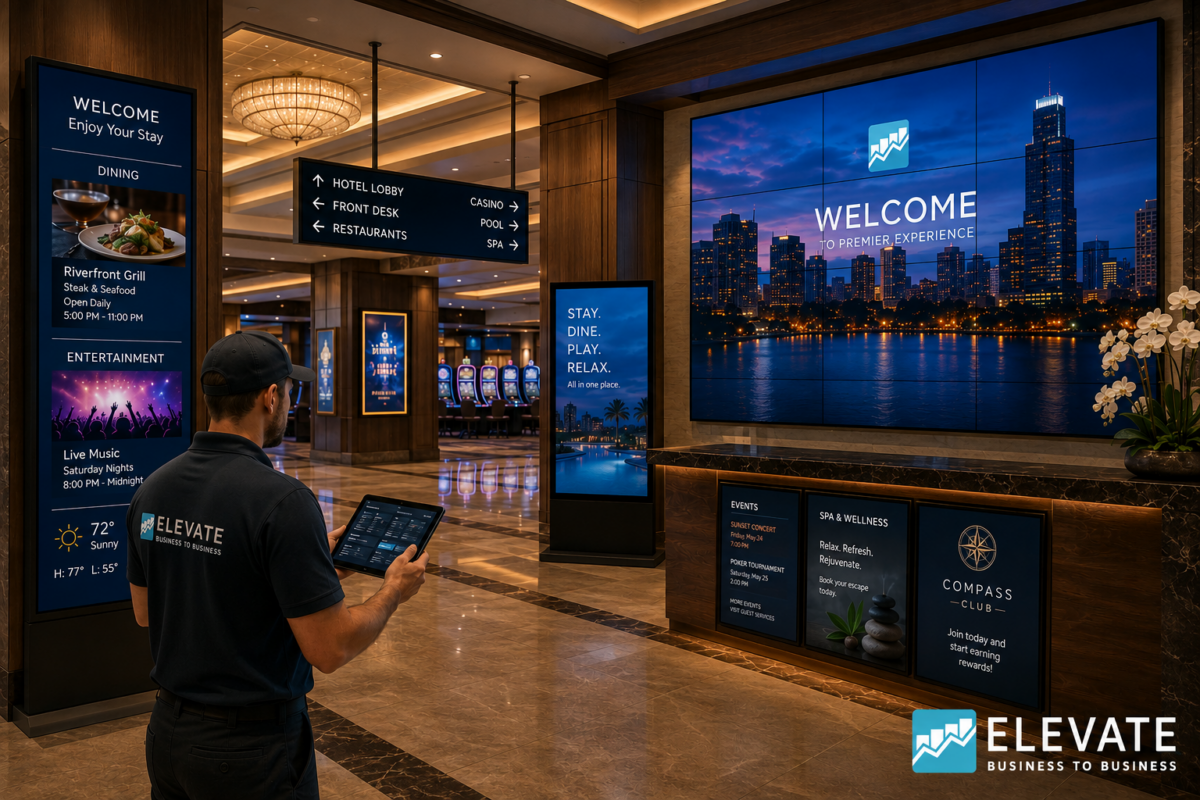
Potential applications include lobby displays, meeting-room signage, conference schedules, wayfinding displays, restaurant menu boards, elevator areas, fitness centers, pool areas, event spaces, casino floors, retail areas, employee communications, outdoor displays, and promotional screens.
This is where a digital signage retrofit can transition from a simple replacement project into a broader guest-engagement strategy.
For more ideas, visit Elevate B2B’s information on hospitality digital signage.
Digital Signage Retrofit Case Study Scenario #1: Hotel Lobby Modernization
Consider a hotel that recently completed a lobby renovation.
The flooring, front desk, furniture, lighting, and décor have all been updated, but several older screens remain mounted throughout the lobby.
The displays still function, so replacing them was initially considered unnecessary.
However, after the renovation, their age becomes much more noticeable.
A retrofit strategy could evaluate the existing mounting locations, wiring, electrical connections, and network infrastructure and determine which components can remain.
Newer commercial displays could then be installed while retaining usable infrastructure.
The hotel receives a more contemporary visual presentation without automatically rebuilding the entire signage system.
Digital Signage Retrofit Case Study Scenario #2: Multi-Location Display Standardization
Imagine a hospitality ownership group with several properties.
Each location purchased displays at different times. One hotel uses one manufacturer, another has a mixture of consumer TVs and commercial displays, and a third property uses older screens that are becoming increasingly difficult to maintain.
Instead of continuing to purchase replacement screens individually, the ownership group develops a phased retrofit plan.
Standard display sizes and approved commercial models are selected.
The group can then replace equipment as properties renovate or displays reach the end of their useful life.
This approach can simplify purchasing, replacement planning, staff training, mounting decisions, and future expansion.
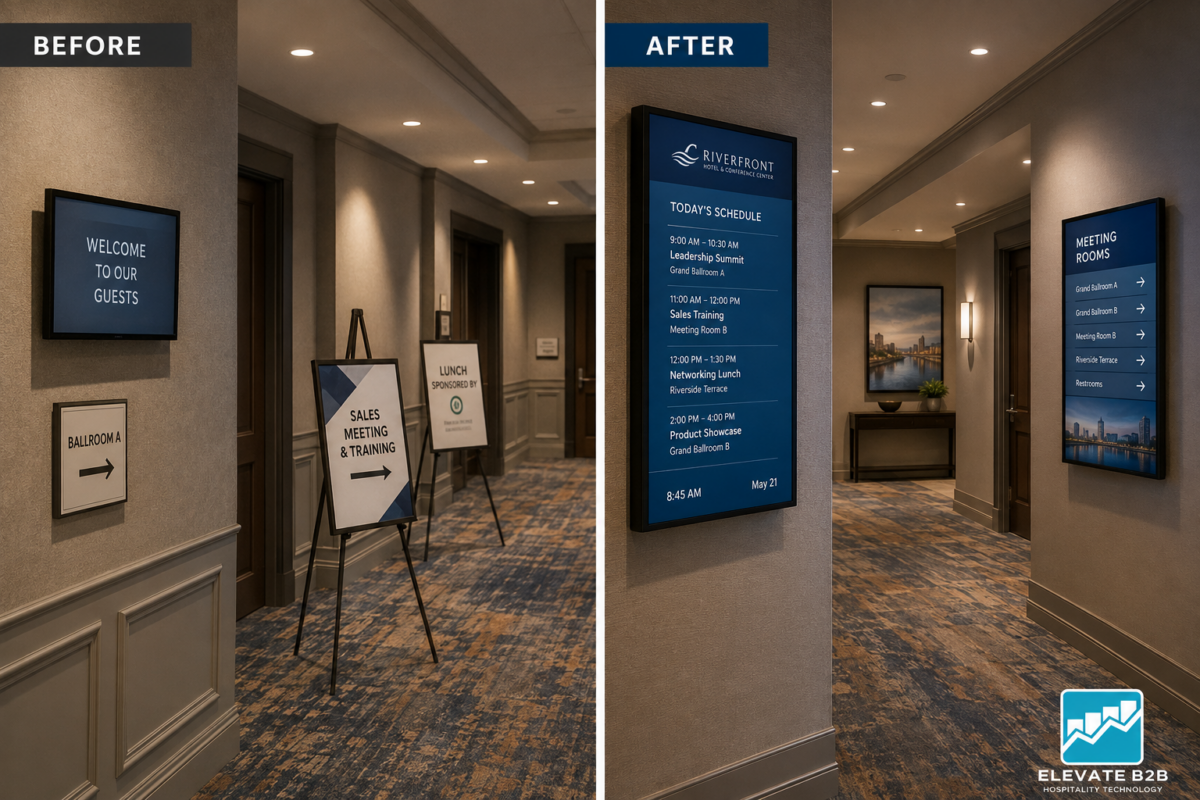
Digital Signage Retrofit Case Study Scenario #3: Conference and Meeting Space Upgrade
Conference facilities depend heavily on communication.
Guests need to know where meetings are located, when events begin, which ballroom is hosting a particular group, and whether schedules have changed.
Printed signs can become outdated almost immediately.
A digital signage retrofit can modernize existing meeting-room displays and directories while taking advantage of existing wiring and display locations.
The result is a more professional experience for event organizers and attendees while giving hotel staff greater flexibility when schedules change.
Turning a Digital Signage Retrofit Into a Smarter Long-Term Investment
Price matters.
Hotel owners and commercial operators need to control capital expenses, particularly when upgrading dozens or hundreds of displays.
But the lowest equipment price does not automatically create the lowest long-term cost.
A digital signage retrofit should be evaluated as an operating investment.
Focus on Cost-Effectiveness, Not Just Initial Cost
A retrofit can be cost-effective precisely because the property evaluates what it already owns.
If wiring, network infrastructure, mounting locations, electrical service, or other equipment can safely remain in service, the project may avoid unnecessary work.
At the same time, retaining obsolete equipment merely to reduce the initial budget can create problems later.
The goal is balance.
Keep what makes sense.
Replace what creates risk, incompatibility, poor performance, or unnecessary maintenance.
Durability and Reliability Matter
Hospitality and commercial displays can operate for long hours in demanding environments.
Reliability therefore matters just as much as image quality.
When a lobby display fails, it is not hidden in a back office. Guests see it.
When one display fails inside a video wall, the problem becomes even more obvious.
A digital signage retrofit gives the organization an opportunity to move away from inconsistent or aging hardware and establish a more reliable equipment strategy.
Improve the Guest Experience
Digital signage should serve a purpose.
That purpose might be helping a guest locate a ballroom.
It could promote dinner reservations.
It might advertise spa services, display transportation information, welcome a conference group, communicate casino promotions, provide property information, or highlight local attractions.
Technology should make information easier to find and easier to update.
For hotels also upgrading guest-room televisions, Elevate B2B offers hospitality TV solutions as well as Samsung hospitality TVs.
Combining public-area signage and guest-room television procurement can also help a property think about technology more strategically instead of treating every display as a completely separate purchase.
Retrofit Digital Signage During a Hotel Renovation or PIP
A hotel renovation or Property Improvement Plan can be an excellent time to evaluate digital signage.
Contractors may already be working in common areas. Walls may already be open. Electrical and network infrastructure may be under review. Furniture, lighting, flooring, and branding may all be changing.
Waiting until construction is complete to consider digital displays can create unnecessary complications.
Instead, signage should be considered during the planning process.
Determine where screens belong.
Determine the correct sizes.
Evaluate sightlines.
Confirm power and network requirements.
Review mounts.
Plan cable management.
Determine content requirements.
This helps digital signage become part of the finished environment instead of something attached to it afterward.
Financing Is Available for Digital Signage Retrofit Projects
A large retrofit can require significant capital, particularly when the project includes dozens of displays, video walls, mounts, installation, or other technology.
Financing is available for qualified Elevate B2B projects.
Financing can help businesses preserve cash and move forward with necessary upgrades rather than postponing a project because the entire purchase would otherwise need to be funded at once.
This can be particularly useful for:
- Hotel renovations
- Property Improvement Plans
- Multi-property upgrades
- Digital signage replacements
- Video wall projects
- Hospitality TV upgrades
- Commercial display installations
- Appliance packages
- Mounting hardware
- Installation-related projects
Ask Elevate B2B about available financing options when requesting your project quote.
Combine Digital Signage With Other Hospitality Technology
A retrofit project may uncover additional technology needs.
Elevate B2B supplies products and services across multiple hospitality and commercial categories, including digital displays, commercial TVs, touch displays, outdoor displays, signage stands, Samsung video walls, Samsung and LG hotel TVs, healthcare TVs, TV mounts, hospitality appliances, minibars, microwaves, refrigerators and freezers, merchandisers, safes, remote controls, TV boxes, installation services, supply-chain solutions, and rescue delivery.
For a hotel undergoing renovation, consolidating related product categories can make procurement easier.
Rather than solving the lobby signage problem today, the guest-room TV problem next month, and the appliance problem later, decision-makers can evaluate the larger scope of the project.
That can be particularly useful for new hotel openings, conversions, renovations, and large-scale property upgrades.
Why Work With Elevate B2B?
Buying commercial displays involves more than finding a screen with the correct diagonal measurement.
A business needs to consider the application, environment, operating schedule, brightness, mounting, infrastructure, compatibility, deployment strategy, and budget.
Elevate B2B works with hospitality and commercial customers looking for solutions from established manufacturers, including Samsung, LG, NEC, Philips, and Sharp for digital signage applications.
Elevate B2B also supports hotels, casinos, healthcare organizations, and commercial businesses with related technology and procurement needs.
If an existing signage system is becoming outdated, you do not necessarily need to decide between keeping everything and replacing everything.
Start with an assessment of what you have.
Then determine the smartest path forward.
Frequently Asked Questions About Digital Signage Retrofit Projects
What is a digital signage retrofit?
A digital signage retrofit modernizes an existing signage installation by replacing or upgrading selected components while potentially retaining usable infrastructure such as wiring, electrical service, mounting locations, network connections, or other equipment.
Is it cheaper to retrofit digital signage than replace the entire system?
It can be. The actual savings depend on the condition and compatibility of the existing infrastructure. A proper assessment should identify what can reasonably remain and what should be replaced.
Can existing digital signage mounts be reused?
Sometimes. Compatibility depends on factors such as display weight, dimensions, VESA mounting pattern, orientation, condition of the mount, wall construction, and access requirements. Mount compatibility should be verified before installing new displays.
Can consumer TVs be replaced with commercial digital signage displays?
Yes. Replacing consumer televisions with commercial displays can be an important part of a retrofit, especially in applications requiring extended operating hours, commercial functionality, improved brightness, or more consistent deployment.
What brands of digital signage does Elevate B2B offer?
Elevate B2B works with commercial digital signage products from manufacturers including Samsung, LG, NEC, Philips, and Sharp.
Can Elevate B2B help with video walls?
Yes. Elevate B2B offers Samsung video wall solutions for commercial applications.
Can a hotel retrofit only part of its digital signage system?
Yes. A phased strategy may make sense for properties with multiple screens or locations. Priority can be given to failing displays, high-visibility areas, renovated spaces, or systems with the greatest operational need.
Should digital signage be upgraded during a hotel renovation?
A renovation or PIP is often an excellent time to evaluate signage because electrical, network, mounting, wall, and design work may already be underway.
Can digital signage be used for hotel conference areas?
Yes. Digital displays can be used for meeting schedules, event directories, ballroom information, wayfinding, sponsor messaging, conference branding, and other event communications.
Does Elevate B2B offer outdoor displays?
Yes. Outdoor displays are among the commercial display categories available through Elevate B2B.
Does Elevate B2B provide mounting solutions?
Yes. Available categories include flat, full-motion/articulating, pivot, press-and-release, pull-out pivot, swivel, tilt, whiteboard mounts, and mount accessories.
Is financing available for digital signage retrofit projects?
Yes. Financing is available for qualified projects. Ask Elevate B2B about financing when requesting a quote for digital signage, hospitality TVs, video walls, mounting hardware, appliances, or other eligible project requirements.
Can Elevate B2B help with more than digital signage?
Yes. Elevate B2B supplies hospitality TVs, digital displays, commercial TVs, touch displays, outdoor displays, video walls, mounts, appliances, minibars, refrigerators/freezers, microwaves, safes, TV accessories, installation services, supply-chain solutions, and rescue delivery services.
Upgrade Your Existing Digital Signage With Elevate B2B
Your existing digital signage infrastructure may have more value than you think.
The answer does not always have to be another temporary replacement screen, nor does it necessarily have to be a complete demolition and rebuild.
A carefully planned digital signage retrofit can help your hotel, casino, healthcare facility, or commercial property modernize its displays while making intelligent use of infrastructure that remains valuable.
The first step is understanding what you currently have and what you want the upgraded system to accomplish.
Elevate B2B is here to help.
Whether you need a few replacement commercial displays, a phased hotel signage upgrade, a video wall, new mounting hardware, a multi-property rollout, or a larger hospitality technology package, Elevate B2B can help you evaluate options for your project.
Financing is available for qualified projects.
You can easily book an appointment online through Elevate B2B or call (833) 351-5333 to discuss your requirements.
Do not wait for outdated screens to fail one at a time.
Build a retrofit strategy that gives your property a modern appearance today and a stronger technology foundation for tomorrow.
Call Elevate B2B today at (833) 351-5333 to request a digital signage retrofit quote.
