

How Many Spare TVs Should A Hotel Order?
A hotel television stops working at 9:30 PM on a Friday. The guest calls the front desk, maintenance is unavailable until morning, and the property has no replacement television in storage.
What should have been a simple equipment swap has suddenly become a guest service problem.
Now the hotel faces several possibilities: moving the guest to another room, issuing a discount, arranging an emergency replacement, or leaving the guest without one of the most frequently used amenities in their room.
This situation raises an important question every hotel owner and purchasing manager should answer before the next equipment failure:
How many spare TVs should a hotel order to prevent unnecessary downtime without wasting money on excess inventory?
The answer depends on your property’s room count, television models, replacement costs, delivery availability, and overall maintenance strategy.
For many hotels, keeping approximately 2% to 5% of their installed guest room television inventory as spare units is a practical starting point. However, a busy resort, remote property, or hotel operating older equipment may need additional replacements.
At Elevate B2B, we help hospitality businesses evaluate commercial television requirements, plan bulk equipment purchases, coordinate delivery, and select compatible products for their properties.
Whether you’re replacing televisions across 50 guest rooms or coordinating a 500-room renovation, having the right replacement inventory can protect your budget and guest experience.
Need help calculating your hotel’s spare television requirements? Call Elevate B2B at (833) 351-5333 or contact our team to discuss your next hospitality TV purchase. Financing is available for qualifying projects.
Table of Contents
PART 1: How Many Spare TVs Does Your Hotel Actually Need?
Understanding the 2% to 5% Spare Television Rule
Hotel television inventory planning should begin with a straightforward calculation.
For a property operating a consistent fleet of commercial-grade televisions, maintaining spare inventory equal to approximately 2% to 5% of the installed units provides an initial planning range.
This recommendation is not a manufacturer’s guarantee or mandatory hospitality standard. It is a practical inventory framework that should be adjusted to match actual equipment performance.
For example, a 100-room hotel with one television in each room might consider keeping two to five replacement units available.
A 200-room hotel could consider four to ten spare units, while a 500-room resort might evaluate a larger reserve based on its television configurations and operational requirements.
Recommended Spare TV Inventory by Hotel Size
| Hotel Size | 2% Reserve | 5% Reserve |
|---|---|---|
| 25 rooms | 1 TV | 2 TVs |
| 50 rooms | 1 TV | 3 TVs |
| 75 rooms | 2 TVs | 4 TVs |
| 100 rooms | 2 TVs | 5 TVs |
| 150 rooms | 3 TVs | 8 TVs |
| 200 rooms | 4 TVs | 10 TVs |
| 300 rooms | 6 TVs | 15 TVs |
| 500 rooms | 10 TVs | 25 TVs |
| 750 rooms | 15 TVs | 38 TVs |
| 1,000 rooms | 20 TVs | 50 TVs |
All fractional quantities are rounded up to the next whole television. These figures assume one installed television per room and are illustrative planning estimates.
Hotels with suites containing multiple televisions should calculate spare inventory using the total number of installed displays rather than room count alone.
A 150-room hotel with 190 installed televisions needs to base its calculation on 190 units, not 150.
The important takeaway is that the right spare television inventory should reflect the equipment actually operating throughout your property.
Why Hotels Should Never Depend on Zero Spare Televisions
A hotel without replacement equipment is dependent on outside suppliers whenever a television fails.
That creates several operational risks.
First, replacement products may not be available immediately. Even if a similar television is in stock, the replacement may not support the hotel’s existing entertainment platform.
Second, expedited freight and emergency purchasing can increase replacement costs.
Third, a room with a malfunctioning television can create guest complaints, compensation requests, or operational disruption.
Finally, equipment failures can become more difficult to manage when a hotel operates multiple television models purchased across different years.
Maintaining a reasonable number of compatible replacements allows maintenance teams to resolve many equipment problems without waiting for a new purchase order.
Five Factors That Determine Your Ideal Spare TV Inventory
1. Hotel size and room configuration
Larger properties typically require more replacement equipment because they operate more televisions. However, room configuration matters just as much as room count.
A resort with televisions in bedrooms, sitting areas, fitness facilities, and executive suites may need several replacement categories.
2. Television age and reliability
A hotel with recently installed commercial-grade televisions may require fewer spare units than a property operating an aging television fleet.
Review maintenance records to identify repeated failures, damaged displays, power issues, and units requiring frequent replacement.
3. Replacement delivery times
Hotels located near distribution centers may have easier access to replacement equipment than remote resorts or properties with limited freight service.
Longer delivery lead times generally justify maintaining a larger reserve.
4. Brand and system compatibility
Not every television is interchangeable.
Hotels using managed entertainment platforms, IPTV technology, or brand-specific guest interfaces must confirm that replacement televisions support their existing systems.
5. Occupancy and guest expectations
Properties operating at high occupancy have fewer alternative rooms available when equipment fails.
Luxury hotels, casinos, convention properties, and upscale resorts may choose larger replacement reserves to minimize guest inconvenience.
Why Commercial-Grade Hospitality TVs Matter
One of the most important decisions in replacement planning is choosing the correct television category.
Consumer televisions may appear less expensive initially, but hospitality televisions are designed with features intended for commercial guest room environments.
Depending on the model and platform, these may include hotel mode settings, centralized configuration, restricted menu access, commercial warranty coverage, and compatibility with hospitality entertainment systems.
For additional information, read our Guide to Hospitality TV, which explains important considerations when selecting televisions for hotels and resorts.
You can also explore our commercial hospitality TV solutions to compare options for new installations and replacement projects.

PART 2: How to Calculate Spare Hotel TVs and Reduce Replacement Costs
Calculate Your Spare TV Inventory Before Ordering
The most effective way to manage replacement televisions is to establish a documented inventory strategy.
Start by identifying the total number of installed televisions, separating them by screen size, manufacturer, model, and entertainment system.
Next, review the number of televisions replaced during the previous 12 to 24 months.
For example, imagine a 200-room hotel with 200 installed televisions.
During the previous year, the maintenance department replaced six televisions because of equipment failures or accidental damage.
That represents an annual replacement rate of 3%.
A reasonable starting point might be six to ten spare televisions, depending on the property’s delivery lead times and operational needs.
However, annual failure history alone does not determine the ideal reserve. Hotels must also consider how quickly replacement stock can be replenished.
A hotel that can receive compatible replacements within two business days may need less on-site inventory than one waiting several weeks.
A Simple Hotel Spare TV Calculation
Use the following formula to establish an initial inventory target:
Total Installed Televisions × Desired Spare Percentage = Spare Television Quantity
For a hotel operating 250 televisions:
250 × 3% = 7.5
Round up to eight spare televisions.
For a more precise approach, also calculate:
Average Monthly TV Replacements × Replenishment Lead Time in Months = Expected Demand During Replenishment
Add an appropriate safety allowance for unexpected failures, damaged units, and demand fluctuations.
The resulting number should then be compared with the property’s minimum operational reserve.
This combination of percentage-based planning and actual replacement history provides a more useful purchasing strategy than relying on room count alone.
Why Ordering Too Few Spare TVs Can Cost More
Consider a hotel that purchases 150 hospitality televisions during a renovation but chooses not to purchase any replacement units.
Several months later, three televisions require replacement.
The original model may no longer be readily available, the supplier may have minimum order requirements, or the hotel may need expedited shipping.
The property could also face additional labor if replacement units require different mounts, remote controls, or programming procedures.
These expenses can make an emergency purchase more costly than including a modest reserve in the original procurement plan.
Purchasing compatible spare televisions during the initial project can also help maintain consistency across guest rooms.
Why Ordering Too Many Spare TVs Is Also a Mistake
More inventory is not automatically better.
Televisions stored for years consume valuable storage space and tie up purchasing capital.
Technology also changes. A television purchased today may become less desirable as hospitality platforms, streaming capabilities, and display standards evolve.
Excessive inventory creates the possibility of owning equipment that is no longer compatible with future renovation plans.
The goal is not to stockpile televisions.
The goal is to maintain enough compatible equipment to support uninterrupted hotel operations while minimizing unnecessary purchasing costs.
Standardize Your Hospitality Television Models
Hotels can simplify replacement planning by reducing the number of television models used throughout the property.
For example, a hotel might standardize guest rooms around one 43-inch television model and premium suites around one 55-inch model.
Instead of maintaining replacement inventory for numerous unrelated products, the property can focus on two compatible equipment categories.
Standardization can make installation, programming, maintenance training, and purchasing more manageable.
However, hotel owners should confirm compatibility with their entertainment platforms before choosing a model.
Some properties operate specialized systems such as Marriott guest room entertainment configurations, IHG STUDIO environments.
These installations may require approved equipment, specific software, or integration procedures.
A television that works perfectly in one hotel may not automatically work with another property’s entertainment system.
Our article on Best Hotel TV Systems provides additional guidance for comparing hospitality entertainment technology.
Samsung Hospitality TVs for Replacement Inventory
Samsung hospitality televisions are an option for properties seeking commercial guest room display solutions.
Depending on the product, Samsung hospitality models may support features such as centralized management, guest-facing entertainment interfaces, and compatibility with selected hospitality technology platforms.
Hotels considering Samsung replacements should verify the exact model number, software requirements, screen size, mounting specifications, and entertainment system compatibility.
Learn more about Samsung Hospitality TVs and how to select equipment for hotel purchasing projects.
LG Hospitality TVs and Mixed-Brand Properties
LG hospitality televisions are another established option for hotel guest room entertainment.
Properties already operating LG commercial televisions may benefit from maintaining compatible replacements within the same equipment family.
However, purchasing by brand alone is insufficient.
Different generations of LG televisions may have different management features, software capabilities, and installation requirements.
Hotels should document the exact model and configuration of each installed unit.
A property operating both Samsung and LG televisions should generally maintain separate compatible replacement inventories unless technical testing confirms that a common replacement model can serve both installations.
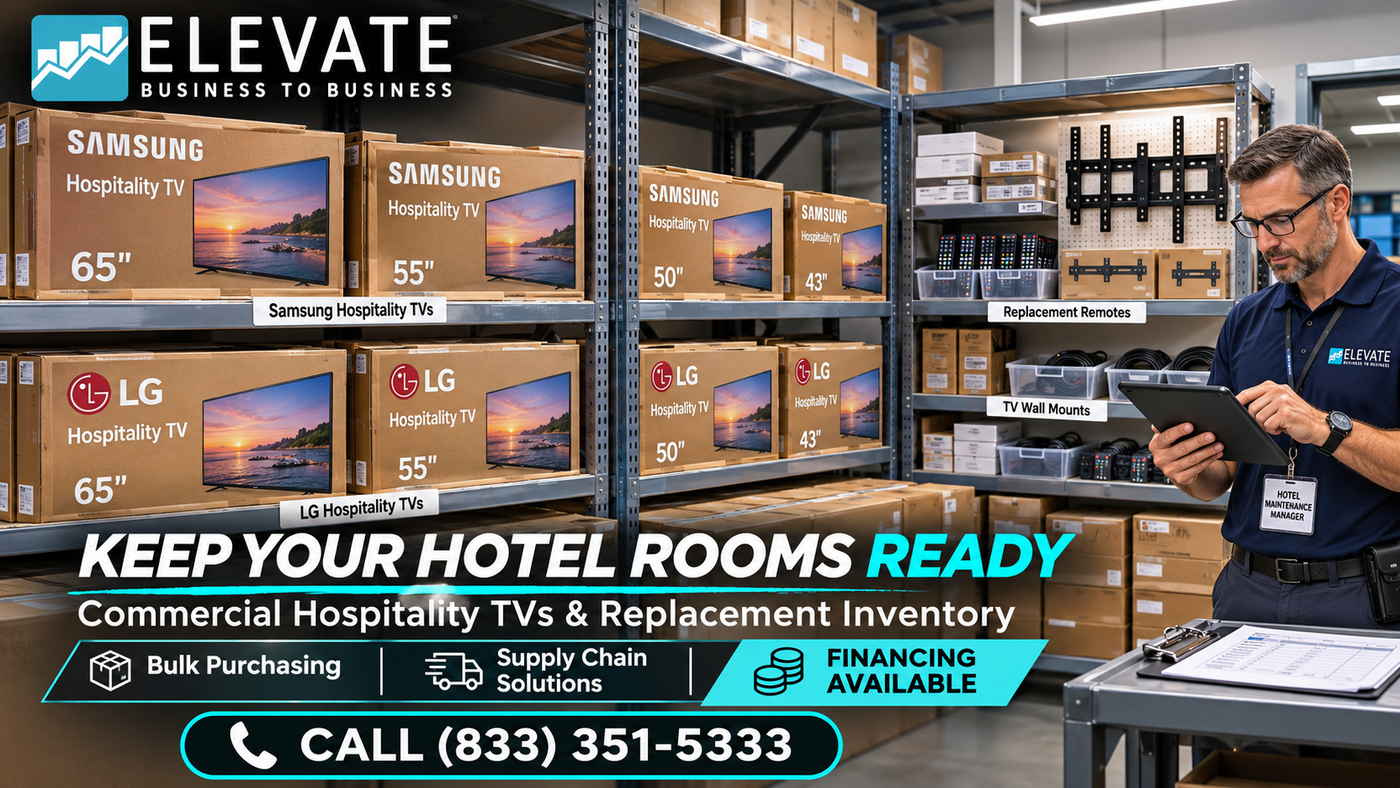
Don’t Forget Television Mounts, Remotes, and Accessories
A replacement television is useful only if maintenance can install and configure it properly.
Hotels should consider keeping compatible accessories alongside their spare television inventory.
Important items may include mounting hardware, remote controls, power cables, approved adapters, and necessary configuration equipment.
Existing wall mounts should be checked for VESA compatibility, weight capacity, and installation requirements before a replacement television is installed.
A different screen size or chassis design may require a new mounting solution.
Elevate B2B also helps hospitality customers source TV mounting solutions and essential television add-ons, reducing the need to coordinate multiple equipment suppliers.
Hotel TV Financing: Manage Replacement Costs Without Delaying Your Project
For many hotel owners, the challenge is not understanding why spare televisions are necessary.
The challenge is finding room in the purchasing budget.
A property completing a renovation may already be investing in flooring, furniture, appliances, guest room technology, and other improvements.
Adding replacement television inventory creates another expense.
Fortunately, financing is available through Elevate B2B for qualifying hospitality equipment purchases.
Rather than excluding necessary replacement equipment from a project solely because of immediate budget constraints, hotel owners can explore financing options as part of their procurement strategy.
Visit the Elevate B2B Financing page to learn more about available financing opportunities and discuss eligibility, terms, and project requirements.
Financing may help qualified businesses manage upfront equipment expenses while preserving working capital for other operational priorities.
Approval, payment amounts, financing costs, and applicable terms depend on the financing provider and the individual transaction.
Planning a hotel renovation or bulk television replacement? Call (833) 351-5333 to discuss equipment pricing and available financing options.

PART 3: Hotel TV Inventory Strategies, Case Studies, and Long-Term Replacement Planning
Create a Hotel TV Replacement Policy
A written replacement policy helps hotel managers and maintenance departments respond consistently when equipment fails.
The policy should identify which television models are approved, how many replacement units must remain in inventory, and who is responsible for purchasing additional stock.
It should also establish a process for testing malfunctioning televisions before replacing them.
Not every reported television problem requires new equipment.
Some issues involve remote controls, input settings, cable connections, network access, or entertainment system configuration.
Maintenance staff should complete basic troubleshooting before removing a television from service.
When replacement is necessary, the property should record the original unit’s serial number, failure reason, replacement model, and installation date.
These records help identify recurring equipment problems and improve future purchasing decisions.
Establish Minimum Inventory and Reorder Points
One effective strategy is to establish a minimum inventory threshold.
For example, a 100-room hotel might maintain five compatible replacement televisions and initiate a replenishment order when inventory drops to two units.
The exact reorder point should reflect how quickly additional televisions can arrive.
Properties experiencing frequent failures or long delivery times may need higher thresholds.
Hotel purchasing teams should also consider seasonal occupancy.
A resort approaching its busiest travel season may want to replenish spare equipment before demand increases.
The same applies to convention hotels preparing for major events.
Coordinate Replacement Inventory Across Multiple Properties
Hotel management companies operating multiple properties may have additional purchasing opportunities.
If several hotels use the same hospitality television models, management may consider coordinating bulk purchases or establishing a shared replacement inventory.
This approach can reduce unnecessary duplication while improving procurement consistency.
However, shared inventory is most practical when properties are geographically close enough for timely delivery.
A spare television located hundreds of miles away may provide little value during an urgent guest room equipment failure.
For nationwide hotel portfolios, a combination of local reserves and coordinated purchasing may be more effective.
Elevate B2B provides hotel TV solutions for hospitality operators evaluating equipment purchases, replacements, and property upgrades.
Illustrative Case Study #1: A 100-Room Hotel With No Spare Televisions
The following case studies are hypothetical planning examples, not documented customer results.
The situation
A 100-room hotel operates 100 commercial televisions but maintains no replacement inventory.
Over a six-month period, four televisions fail or become damaged.
Each replacement requires a separate purchasing process, and the hotel occasionally experiences delays obtaining compatible equipment.
The proposed solution
Management introduces a five-unit spare inventory policy.
The hotel also standardizes future replacement purchases around a compatible commercial television model.
The potential operational benefit
Maintenance can replace failed equipment from on-site inventory instead of waiting for each new order.
The hotel can also track replacement frequency and replenish inventory before it reaches zero.
The primary advantage is improved preparedness, not a guaranteed reduction in total equipment spending.
Illustrative Case Study #2: A 250-Room Hotel Renovation
The situation
A 250-room property plans a complete guest room television upgrade.
Management intends to purchase 250 televisions but has not included replacement inventory in the renovation budget.
The proposed solution
The purchasing team evaluates a 3% reserve, equivalent to eight spare televisions.
The project order becomes 258 units rather than 250.
The team also confirms that the replacement units match the installed model and hospitality entertainment configuration.
The potential operational benefit
The property begins operating its upgraded television system with compatible replacement equipment available.
Including spare units in the initial purchasing plan may also simplify procurement and delivery coordination.
The hotel can explore financing options for qualifying equipment purchases if upfront budget management is a concern.
Illustrative Case Study #3: A 500-Room Resort With Multiple TV Sizes
The situation
A large resort operates 500 televisions across standard rooms, suites, and premium accommodations.
The property uses 43-inch, 50-inch, and 55-inch displays.
A single spare television model cannot serve every guest room.
The proposed solution
The purchasing team divides installed televisions into compatible model groups.
Instead of ordering 25 identical spare units, the resort distributes its reserve according to the number of installed displays in each category and the replacement history of those units.
The potential operational benefit
Maintenance has access to more appropriate replacement equipment for different room configurations.
The property also reduces the risk of purchasing spare televisions that cannot be installed where needed.
This example demonstrates why inventory planning must consider compatibility, not just the total number of televisions.
When Should Hotels Replace All Their Televisions Instead of Buying Spares?
Maintaining spare inventory makes sense when the existing television fleet remains dependable, compatible, and economically practical to maintain.
However, replacement planning changes when televisions begin reaching the end of their useful service life.
A hotel may need to consider a broader upgrade when equipment failures become frequent, replacement models are difficult to source, or guest entertainment requirements exceed the capabilities of installed televisions.
Other warning signs include inconsistent picture quality, obsolete connectivity, unsupported management software, and increasing maintenance labor.
Hotels should compare the cost of continued repairs with the long-term value of a planned television refresh.
For properties considering newer guest entertainment technology, our guide to Smart TVs for Hotels explains considerations when evaluating modern hospitality television capabilities.
Consider Hotel Digital Signage During Your Equipment Planning
Guest room televisions are only one part of a hotel’s display infrastructure.
Properties may also operate commercial displays in lobbies, restaurants, meeting rooms, conference facilities, and public areas.
These installations often require different hardware than guest room televisions.
A commercial digital signage display may need extended operating hours, specialized mounting, content management, or video wall compatibility.
For these applications, explore Digital Signage Solutions and our article about Hospitality Digital Signage.
Combining display procurement planning with guest room television purchasing can help hotel operators coordinate equipment specifications and delivery schedules.
How Elevate B2B Helps Hotels Plan Spare TV Inventory
Purchasing hospitality televisions involves more than choosing a screen size and comparing prices.
Hotel owners must consider equipment compatibility, commercial reliability, purchasing budgets, installation requirements, delivery logistics, and long-term maintenance.
Elevate B2B helps hospitality businesses navigate these decisions through commercial equipment sourcing and project support.
Our product and service categories include:
- Samsung and LG hospitality televisions for hotel guest rooms.
- Commercial displays and digital signage solutions.
- Television mounts, remote controls, and compatible accessories.
- Bulk hospitality equipment purchasing.
- Supply chain solutions and delivery coordination.
- Installation services and rescue delivery support.
- Hospitality appliances and other property equipment.
- Financing options for qualifying purchases.
Whether your property needs three spare televisions or several hundred new guest room displays, our team can help evaluate the purchasing requirements.
Visit our Hotel TVs page to learn more about commercial television options for hospitality environments.
Call Elevate B2B at (833) 351-5333 to request assistance with your hotel’s television inventory and replacement purchasing strategy.

Frequently Asked Questions About Hotel Spare TVs
1. How many spare TVs should a 100-room hotel keep?
A 100-room hotel with one television per room might begin with two to five spare televisions, representing approximately 2% to 5% of its installed inventory. The ideal quantity depends on equipment reliability, replacement lead times, and compatibility requirements.
2. Should hotels keep spare TVs in storage?
Yes, maintaining a reasonable reserve can help hotels replace malfunctioning equipment without waiting for new deliveries. Spare televisions should be stored securely in a clean, dry, climate-appropriate environment and protected from physical damage.
3. How many spare TVs does a 200-room hotel need?
A 200-room hotel operating 200 televisions could consider four to ten spare units as an initial planning range. Properties with multiple television sizes or older equipment may require a different distribution.
4. Should hotels purchase spare TVs during renovations?
Purchasing spare televisions during a renovation can help ensure model consistency and simplify equipment sourcing. Hotels should confirm that the spare units match their installed television systems and are included in the procurement budget.
5. Are commercial hospitality TVs better than regular consumer TVs?
Commercial hospitality televisions are generally better suited to hotel operations because selected models offer features such as hotel mode, management controls, and hospitality platform compatibility. The appropriate choice depends on the property’s requirements and the manufacturer’s warranty terms.
6. How often should hotels replace guest room televisions?
There is no universal replacement schedule. Hotels should evaluate television age, maintenance costs, guest expectations, software support, image quality, and compatibility with current entertainment platforms. A planned replacement program is often more manageable than repeated emergency purchases.
7. Can hotels use different brands for spare televisions?
Sometimes, but compatibility must be verified. A replacement television must work with the property’s entertainment system, mounting hardware, remote controls, and configuration requirements. Using the same brand does not automatically guarantee compatibility.
8. Can hotels finance bulk hospitality TV purchases?
Financing is available through Elevate B2B for qualifying projects. Eligibility and financing terms vary. Visit the Elevate B2B Financing page or call (833) 351-5333 for more information.
9. Should hotels stock extra remote controls and TV mounts?
Yes. Compatible remote controls, mounting accessories, and necessary installation hardware can help maintenance departments complete replacements efficiently. Hotels should confirm accessory compatibility with each approved television model.
10. Where can hotels order hospitality televisions in bulk?
Hotel owners and procurement teams can contact Elevate B2B for assistance sourcing Samsung and LG hospitality televisions, commercial displays, accessories, and equipment for multi-room purchasing projects.
Final Thoughts: Protect Your Guests, Your Budget, and Your Hotel Operations
A spare television may not seem like a major investment when planning a hotel renovation or equipment purchase.
However, the absence of replacement equipment can create avoidable maintenance delays, guest complaints, and purchasing complications.
For many hotels, maintaining a spare inventory of approximately 2% to 5% provides a useful starting point.
The final quantity should reflect your property’s actual television count, equipment age, failure history, room configurations, and supplier delivery capabilities.
Just as importantly, replacement televisions must be compatible with the systems already operating throughout the hotel.
A well-planned inventory strategy helps property managers prepare for equipment failures rather than reacting to them.
Get Expert Help With Your Hotel TV Inventory
Elevate B2B is here to help.
From hospitality television purchasing and replacement planning to commercial display solutions, accessories, delivery coordination, and installation services, we help hotel operators make more informed equipment decisions.
Whether you’re purchasing replacement units for an existing property or planning a complete television upgrade, our team can discuss equipment options and project requirements.
Financing is available for qualifying purchases.
Don’t wait until a guest room television fails to discover that your property has no compatible replacement available.
Call Elevate B2B today at (833) 351-5333 or visit our website to contact us and arrange an appointment.
Elevate B2B — Your Partner for Hospitality TVs, Commercial Displays, and Hotel Equipment Solutions.
